peter vink
work cv about contact news
ENG | NL

Peter Vink is a conceptual artist working with light and other materials, known for his site-specific installations that transform spaces into a dense layering of memory and meaning.

Peter Vink is een conceptueel kunstenaar die werkt met licht en andere materialen, bekend om zijn site-specific installaties die ruimtes transformeren tot een dichte gelaagdheid van geheugen en betekenis.

Peter Vink — OPAL
OPAL 2026 — Oberen Zehntausend, Pätz, Germany
Peter Vink — Hetty Voute und Gisela Sohnlein at Schloss Biesdorf
Hetty Voute und Gisela Sohnlein at Schloss Biesdorf 2025 — Schloss Biesdorf, Berlin
Peter Vink — Ruimte III Rockin
Ruimte III Rockin 2025 — Arti Amicitae, Amsterdam
Peter Vink — Kerk Hegebeintum
Kerk Hegebeintum 2024 — Reformed church Hegebeintum, the Netherlands
Peter Vink — Constantia
Constantia 2024 — Lachenmann Art, Konstanz, Germany
Peter Vink — de Gouden Bocht
de Gouden Bocht 2023 —
Peter Vink — Burgerweeshuis I / II
Burgerweeshuis I / II 2023 — Burgerweeshuis, Amsterdam
Peter Vink — Bridge 242
Bridge 242 2022 — Magere Brug, Amsterdam
Peter Vink — Binckhorst
Binckhorst 2022 — Binck Kade apartment complex, The Hague
Peter Vink — F15
F15 2022 — Rijkskantoor Fellenoord 15, Eindhoven, the Netherlands
Peter Vink — Mr. J.J. van der Veldebrug
Mr. J.J. van der Veldebrug 2018 — Amsterdam
Peter Vink — Pouwel Bakhuis
Pouwel Bakhuis 2021 — IJsselbiënnale, Wapenveld, the Netherlands
Peter Vink — Gleisdreieck
Gleisdreieck 2020 — Wiedererwachen, Berlin, Germany
Peter Vink — Absperrgitter
Absperrgitter 2020 — Wiedererwachen, Berlin, Germany
Peter Vink — Hengelo
Hengelo 2020 — City hall Hengelo, the Netherlands
Peter Vink — project space @ ekwc
project space @ ekwc 2019 — sundaymorning @ ekwc
Peter Vink — Kalverstraat Bijlmerbajes
Kalverstraat Bijlmerbajes 2018 — Big Art Bijlmerbajes, Amsterdam
Peter Vink — Pomphuisje 2 Radio Kootwijk
Pomphuisje 2 Radio Kootwijk 2018 — Radio Kootwijk, Grasnapolsky Festival
Peter Vink — M21
M21 2015 — 21st Century Minsheng Museum, Shanghai
Peter Vink — Zonnestraal
Zonnestraal 2014 — Landgoed Zonnestraal, Hilversum
Peter Vink — de Biesboschhal II
de Biesboschhal II 2013 — Dordtyart, Dordrecht
Peter Vink — de Biesboschhal
de Biesboschhal 2013 — Dordtyart, Dordrecht
Peter Vink — S.J. van Embden monument
S.J. van Embden monument 2011 — Eindhoven University of Technology TUe, the Netherlands Glow International Forum of Light in Art and Architecture, Eindhoven
Peter Vink — de Schinkel
de Schinkel 2011 — KADS, Art along the Schinkel, Amsterdam
Peter Vink — N 52 14.053, E 6 53.796 - N 52 13.247, E 6 53.738
N 52 14.053, E 6 53.796 - N 52 13.247, E 6 53.738 2011 — Roombeek, Enschede, the Netherlands
Peter Vink — Raamsteeg 2
Raamsteeg 2 2010 — Depot National Museum of Natural History, National Museum of Antiquities & National Museum of the History of Science and Medicine Leiden, the Netherlands
Peter Vink — Wissehaege
Wissehaege 2009 — Wissehaege, Eindhoven, the Netherlands
Peter Vink — Connections [Schakels]
Connections [Schakels] 2006 — W139, location post CS, Amsterdam
Peter Vink — Soo
Soo 2001 — Gerrit Rietveld Academie, Amsterdam
Peter Vink — de Gegeven Ruimte (plan D)
de Gegeven Ruimte (plan D) 2025 — Update, Arti Amicitae, Amsterdam
Peter Vink — Luchtroosters
Luchtroosters 2025 — Arti Amicitae, Amsterdam
Peter Vink — Petruskerk, Pieterburen
Petruskerk, Pieterburen 2024 — Pieterburen, the Netherlands
Peter Vink — Petrus en Pauluskerk Usquert
Petrus en Pauluskerk Usquert 2024 — Usquert, the Netherlands
Peter Vink — Sint Willibrorduskerk Holwerd
Sint Willibrorduskerk Holwerd 2024 — Holwerd, the Netherlands
Peter Vink — Radiator
Radiator 2024 — Hilbertraum,"Erregung öffentlicher Freude”, Berlin, Germany
Peter Vink — Moreelsebrug
Moreelsebrug 2024 — Utrecht, the Netherlands
Peter Vink — de rode ruimte
de rode ruimte 2023 — Artphy, Onstwedde, the Netherlands
Peter Vink — 100
100 2023 — Lachenmann Art Frankfurt, Germany
Peter Vink — Malerij Noordkade
Malerij Noordkade 2022 — De Compagnie, Cultuurfabriek - Noordkade, Veghel
Peter Vink — Tetterode
Tetterode 2022 — Residential building Tetterode, Amsterdam
Peter Vink — 1495 - Artphy
1495 - Artphy 2022 — Artphy, buitengebied, Onstwedde, the Netherlands
Peter Vink — Schelling
Schelling 2022 —
Peter Vink — Platfrom 04
Platfrom 04 2022 — Platform, Utrecht CS
Peter Vink — Pflasterfliesen
Pflasterfliesen 2021 — Gallery Art Engert, Eschweiler, Germany
Peter Vink — Rio Reiser Weg
Rio Reiser Weg 2021 — Centre for international light art, Unna, Duitsland
Peter Vink — ADHOC
ADHOC 2021 — Adhocraum, Bochum, Germany
Peter Vink — B67
B67 2021 — Temporary accommodation of the The House of Representatives (Tweede Kamer) Den haag
Peter Vink — Lachenmann
Lachenmann 2021 — Lachenmann, Frankfurt, Germany
Peter Vink — Project.Fabriek lokatie B37
Project.Fabriek lokatie B37 2020 — BIG ART Hembrug, Zaandam
Peter Vink — Kerksteeg – Toren Sint Jan
Kerksteeg – Toren Sint Jan 2019 — Gouda, the Netherlands
Peter Vink — Fietssluis Oosterpark / Linnaeusstraat
Fietssluis Oosterpark / Linnaeusstraat 2019 — Parklicht, Oosterpark, Amsterdam
Peter Vink — Hembrug 072
Hembrug 072 2019 — Big Art Hembrug
Peter Vink — Aquabit II
Aquabit II 2019 — aquabitArt gallery, Berlin, Germany
Peter Vink — JOH3
JOH3 2019 — JOH3 gallery
Peter Vink — studio 2 @ ekwc
studio 2 @ ekwc 2019 — sundaymorning @ ekwc
Peter Vink — Muziekkoepel Oosterpark
Muziekkoepel Oosterpark 2018 — Parklicht, Amsterdam
Peter Vink — Bois de Ligne, no. 23 Sites en Ligne
Bois de Ligne, no. 23 Sites en Ligne 2018 —
Peter Vink — Tropen Hotel
Tropen Hotel 2017 — Parklicht, Oosterpark, Amsterdam
Peter Vink — Kattenburgerstraat 5
Kattenburgerstraat 5 2017 — Amsterdam Light Festival, Marinetrerrein, Amsterdam
Peter Vink — Krakralucha Park
Krakralucha Park 2017 — Studio Complex & Hangarrrrrr, “Wasteland Interventions”, Enschede
Peter Vink — Aquabit
Aquabit 2017 — Aquabit Art Gallery, Berlin
Peter Vink — DISKURS
DISKURS 2016 — Diskurs, “Midnight Sun”, Berlin
Peter Vink — Expositieruimte 1 Concordia
Expositieruimte 1 Concordia 2016 — Concordia, Enschede, the Netherlands
Peter Vink — 1495
1495 2016 — DordtYart, Dordrecht, the Netherlands,
Peter Vink — Schieoevers
Schieoevers 2015 — Overschiese weg, Schiedam, the Netherlands
Peter Vink — Workshop 8
Workshop 8 2015 — Swatch Art Peace Hotel, Shanghai
Peter Vink — 67 Huqiu road
67 Huqiu road 2015 — Rockbund Art Museum Shanghai
Peter Vink — Schiehal H Plan B
Schiehal H Plan B 2015 — van Nelle Fabriek, Art Rotterdam
Peter Vink — CBK Amsterdam
CBK Amsterdam 2014 — Oost CBK Amsterdam Oost, show: “Hanging Around”
Peter Vink — Julianapark Schiedam
Julianapark Schiedam 2013 — Winterlicht, Schiedam
Peter Vink — Piushaven Tilburg
Piushaven Tilburg 2013 — Piushaven Lichtfeest, Tilburg, the Netherlands
Peter Vink — the Movies
the Movies 2013 — the Movies, Dordrecht
Peter Vink — Oude Markt 3
Oude Markt 3 2012 — Oude markt 3, Sittard, the Netherlands
Peter Vink — Yard Space Station 65
Yard Space Station 65 2012 — Space Station 65, London
Peter Vink — outLINE
outLINE 2012 — Stichting outLINE, Amsterdam, Netherlands
Peter Vink — V Art Center
V Art Center 2012 — Building 3 Room 201 V Art center, Solar Plexus, My people project, Shanghai
Peter Vink — Javaplein 12F
Javaplein 12F 2012 — Polderlicht Foundation, City city council Amsterdam East
Peter Vink — AM Art Space
AM Art Space 2011 — AM Art Space, Shanghai, China
Peter Vink — Hoedemakerssteeg
Hoedemakerssteeg 2011 — VHDG, Leeuwarden, the Netherlands
Peter Vink — Corner Industrieweg - de Boerlaan
Corner Industrieweg - de Boerlaan 2011 — Art-end-house,Deventer, the Netherlands
Peter Vink — Witte de Withstraat 89
Witte de Withstraat 89 2010 — Zoete-broodjes, Amsterdam, the Netherlands
Peter Vink — Metro station Wibautstraat
Metro station Wibautstraat 2010 — Etalage galerie Inkijk, Amsterdam, the Netherlands
Peter Vink — Skybox
Skybox 2009 — Amsterdam, Netherlands
Peter Vink — Stadsdeelhuis Oost
Stadsdeelhuis Oost 2009 — City hall East, Amsterdam, the Netherlands
Peter Vink — Garden CBK Dordrecht
Garden CBK Dordrecht 2009 — CBK Art Centre Dordrecht, the Netherlands, July
Peter Vink — Space A - Platform China
Space A - Platform China 2008 — Platform China Contemporary Art Institute, Beijing, China
Peter Vink — F6
F6 2008 — Jiu Chang Art Complex, Beijing, China
Peter Vink — ROOK
ROOK 2008 — Jiu Chang Art Complex, Beijing, China
Peter Vink — SYB
SYB 2008 — SYB Art House, Beetsterzwaag, the Netherlands
Peter Vink — Van der Vijverstraat
Van der Vijverstraat 2007 — Van der Vijverstraat, Amsterdam, the Netherlands, October
Peter Vink — Necktie Highway
Necktie Highway 2007 — Zuidplein, Amsterdam the Netherlands, September
Peter Vink — de Fabriek
de Fabriek 2007 — De fabriek, Eindhoven, the Netherlands, April
Peter Vink — de Pekelzaal  [The Brining Room]
de Pekelzaal [The Brining Room] 2006 — KIK foundation, Kolderveen, the Netherlands
Peter Vink — Untitled
Untitled 2004 — Living room, Utrecht, Netherlands
Peter Vink — Arti et Sedibus
Arti et Sedibus 2003 — Arti et Amicitae, Amsterdam
Peter Vink — Veld loop
Veld loop 2003 — Portiershuisje [Porter's lodge] Stadionplein, Amsterdam
Peter Vink — 29
29 2002 — de Branderij, Antwerp
Peter Vink — Domain
Domain 2002 — Centre for Visual Arts (CBK), Dordrecht, the Netherlands
Peter Vink — 1982
1982 2000 — Subway station Gerdesiaweg, Rotterdam,
← work

Heilzeichen

Kesselhaus Herzberge, Berlin, 2026

Light installation: aluminium, LED technology, red light

In the basement of Kesselhaus Herzberge — directly beneath the boilers that once supplied the entire hospital grounds with power and heat — Peter Vink constructs a three-dimensional red cross whose dimensions are determined by the pillars and the existing platform of the space.

In de kelder van het Kesselhaus Herzberge — direct onder de ketels die ooit het gehele ziekenhuisterrein van stroom en warmte voorzagen — construeert Peter Vink een driedimensionaal rood kruis.

Im Keller des Kesselhaus Herzberge konstruiert Peter Vink ein dreidimensionales rotes Kreuz.

← work
← work
Peter Vink — OPAL, site-specific light installation

OPAL

Oberen Zehntausend, Pätz, Germany, 2026

LICHTUNG

Blue lasers, wood, LED strips, aluminium profiles

2.1 x 1.4 x 1000 metres

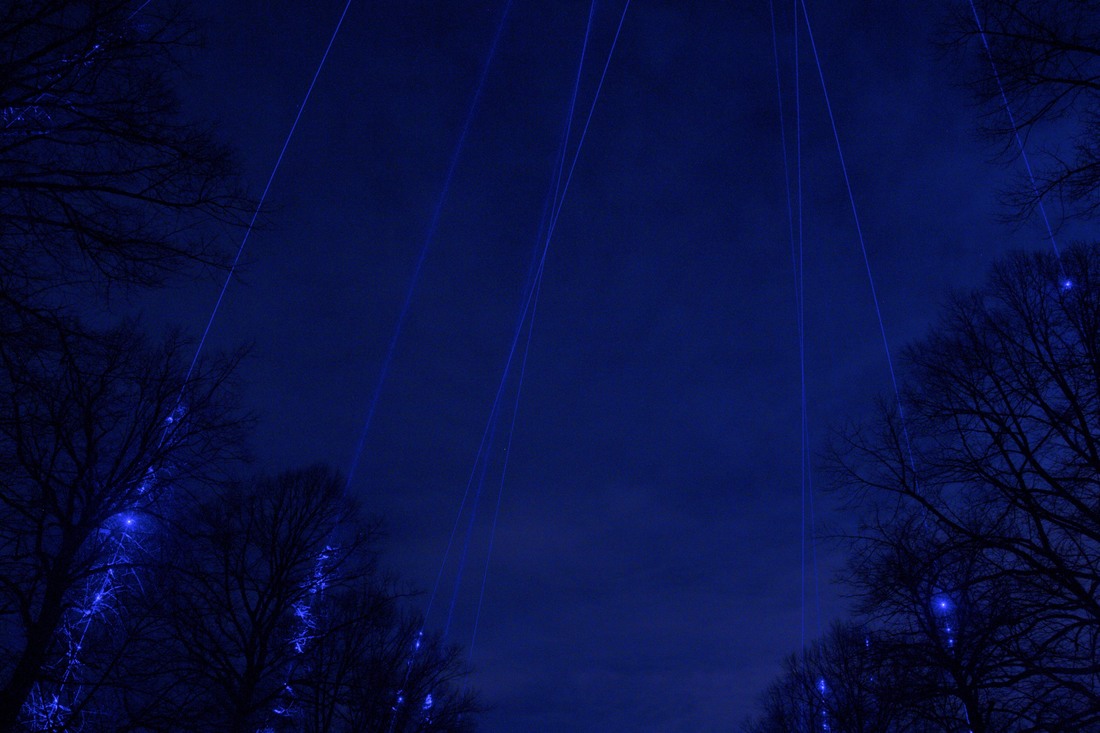
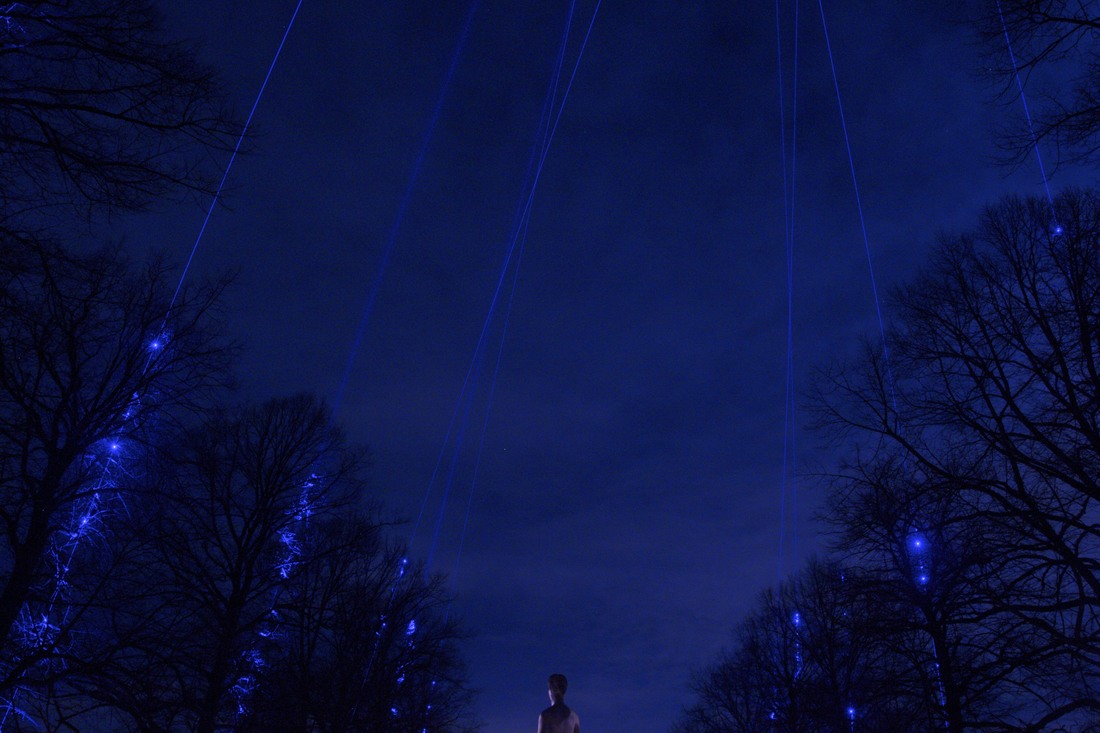
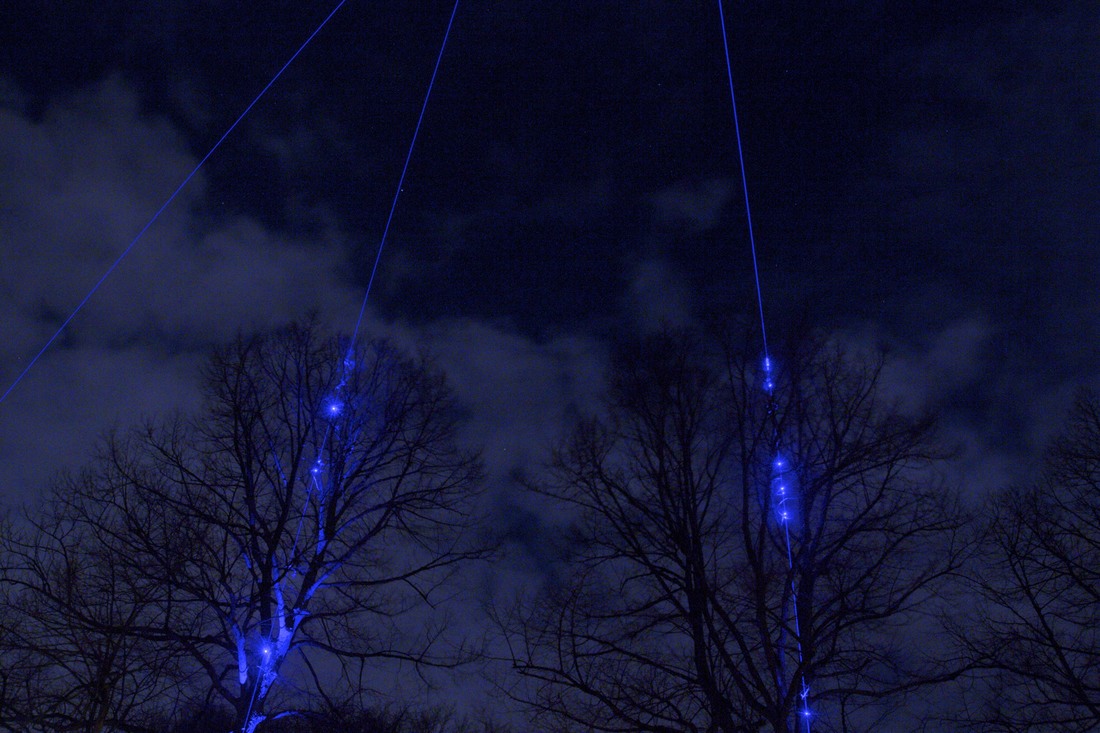
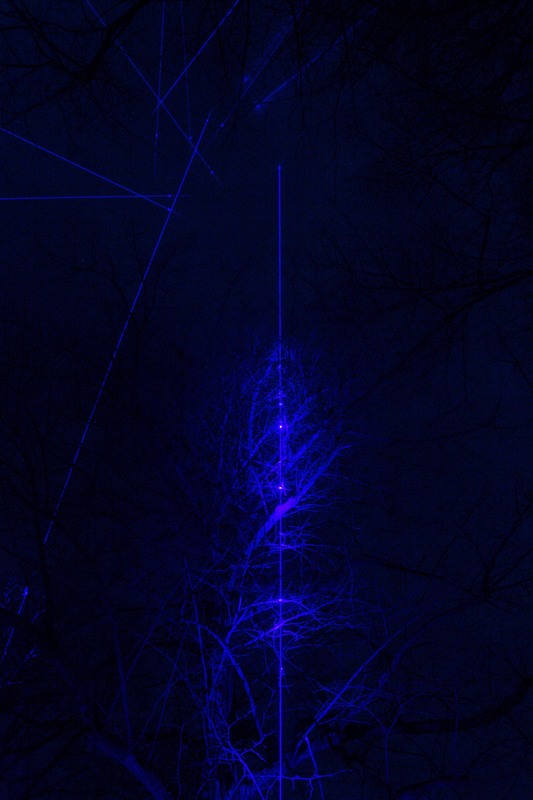
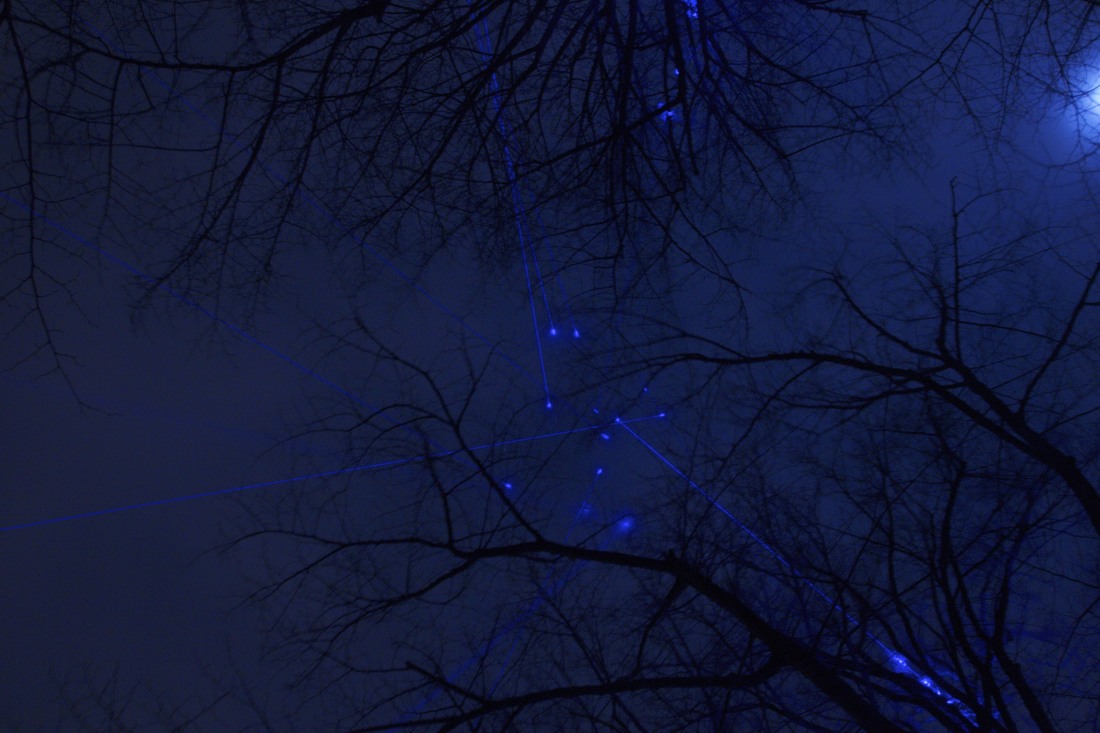
Below the forest near Pätz, Brandenburg, gas once flowed — invisible, silent, always present. In 2025, the conversion of OPAL to hydrogen transport began. Every day an inspection helicopter flies over the route — the only visible sign of what lies beneath the ground.

Above ground, the OPAL pipeline traces itself as a bare, gently curving strip through the landscape, where the trees have made way for the pipe below. OPAL — Ostsee-Pipeline-Anbindungsleitung — is the overland connection of Nord Stream 1, the notorious Russian-German gas pipeline that supplied Europe with energy for decades while simultaneously holding it captive in geopolitical dependency.

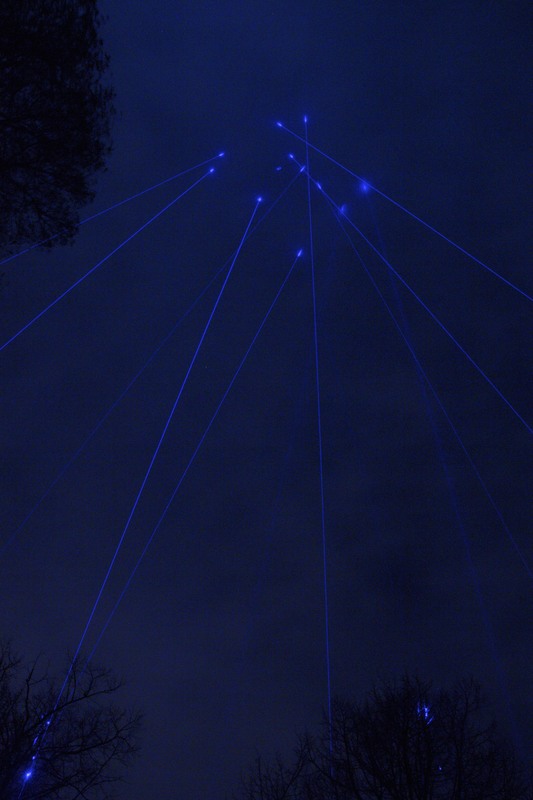
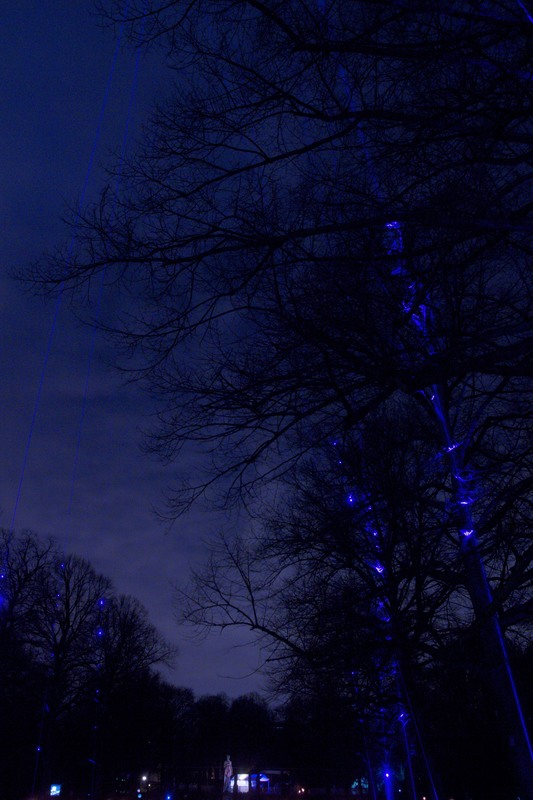
In this site-specific installation, Peter Vink investigates the tension between visibility and concealment. The cleared strip of forest serves as a stage for a kilometre-long line of light. A first circle of 1.4 metres in diameter — the exact diameter of the pipe below — marks the starting point. The letters OPAL and PÄTZ are overlaid in a shared grid — each letter appearing only once, in its own colour. The overlap reveals itself only on closer inspection — like the infrastructure beneath.
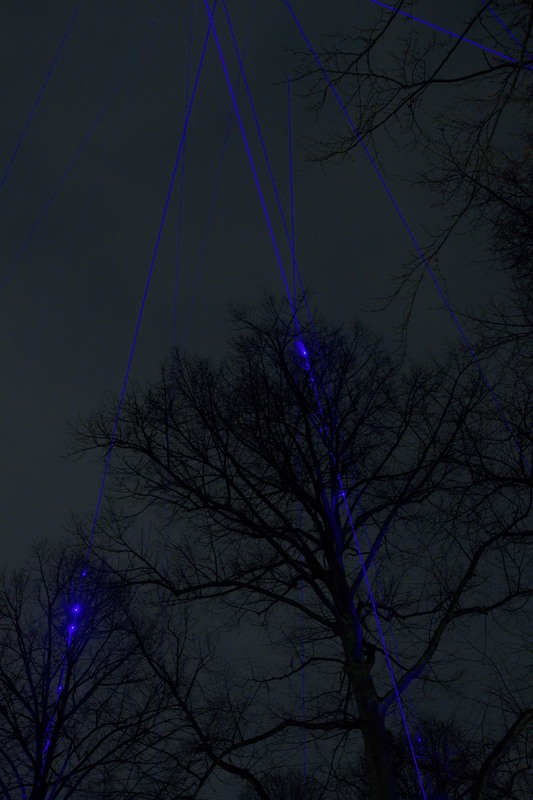
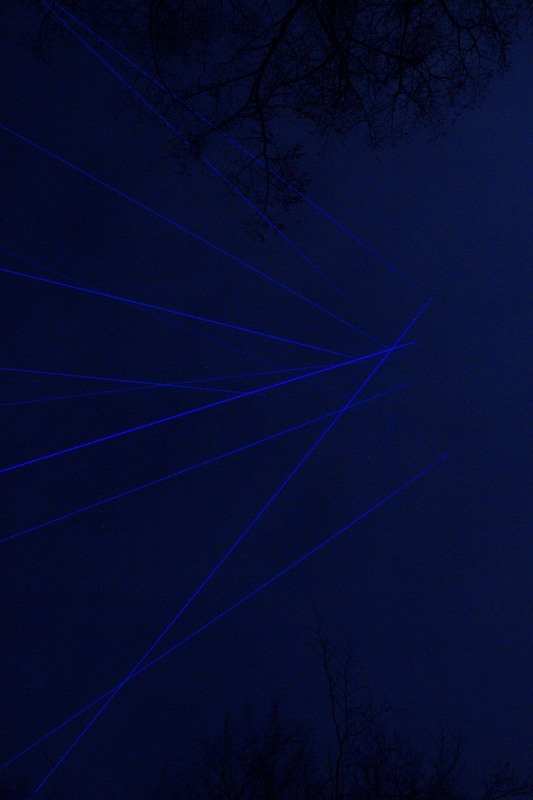
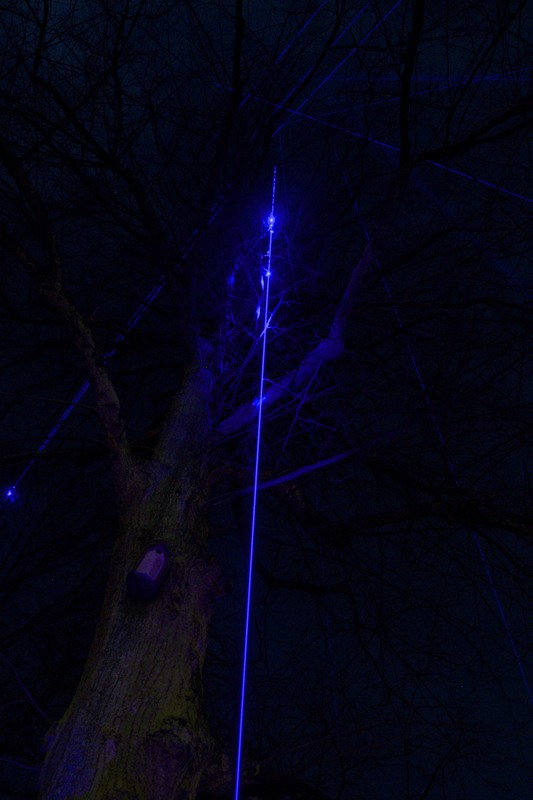
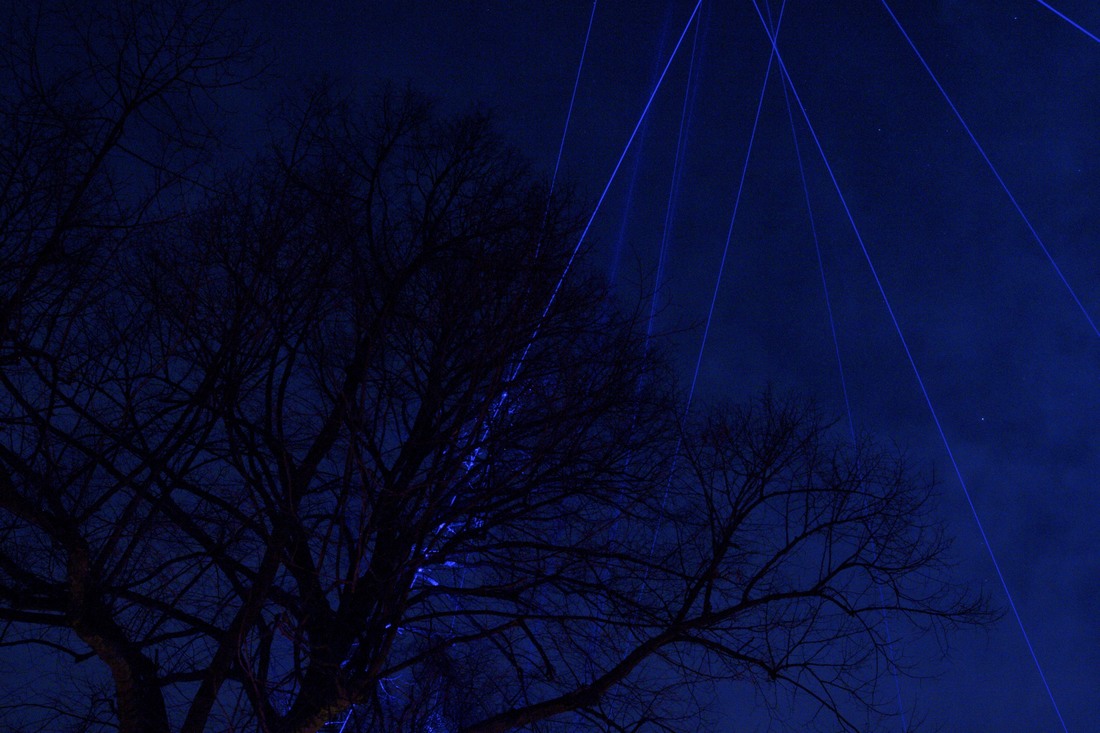
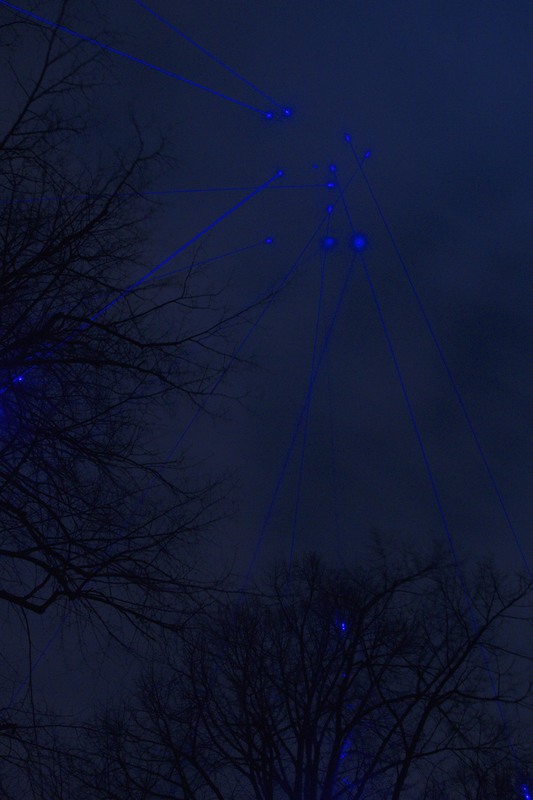
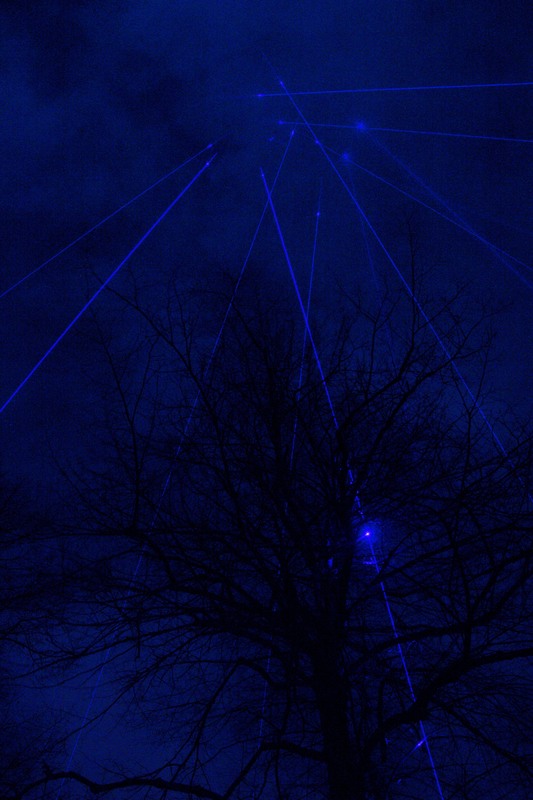
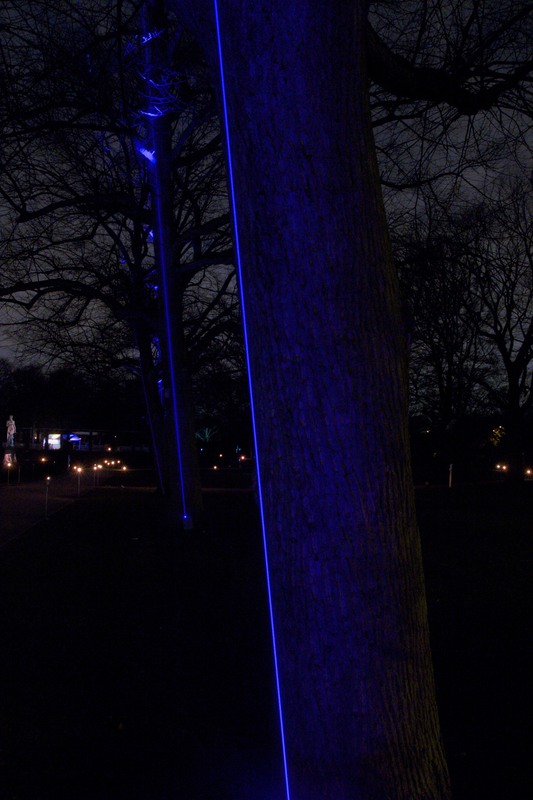
The installation is structured as a chain of five beacons. Each laser bridges a distance of 250 metres, ending on the white wooden face of the next circle, while the next beam departs from its reverse side. The gentle curve determines what is visible: lasers gradually disappear around the bend and the next circle slowly emerges from the darkness. On the white wooden circles, the blue laser light pulses and flickers.

The walk ends at the final beacon. Only by walking around the fifth portal is the reverse side revealed: a cross lit up brilliantly in blacklight, following the vertical pole and horizontal construction. An industrial requiem; a monument to the fossil age that is slowly writing itself toward its end.

Onder het bos bij Pätz, Brandenburg, stroomde gas — onzichtbaar, geruisloos, altijd aanwezig. In 2025 begon de omschakeling van de OPAL naar waterstooftransport. Dagelijks vliegt een inspectiehelikopter over de trasse — het enige zichtbare teken van wat er onder de grond schuilt.

Boven de grond tekent de OPAL-pijpleiding zich af als een kale, licht gebogen strook door het landschap, waar de bomen zijn geweken voor de pijp daaronder. OPAL — Ostsee-Pipeline-Anbindungsleitung — is de landverbinding van Nord Stream 1, de beruchte Russisch-Duitse gaspijpleiding die Europa decennialang van energie voorzag en tegelijkertijd gevangen hield in geopolitieke afhankelijkheid.

In deze locatiespecifieke installatie onderzoekt Peter Vink de spanning tussen zichtbaarheid en verborgenheid. De kaalslag in het bos fungeert als podium voor een kilometer lange lichtlijn. Een eerste cirkel van 1,4 meter doorsnede — de exacte diameter van de pijp daaronder — markeert het startpunt. De letters OPAL en PÄTZ zijn over elkaar heen gelegd in een gedeeld grid — elke letter verschijnt slechts één keer, in een eigen kleur. De overlapping onthult zich pas bij goed kijken — zoals de infrastructuur daaronder.

De installatie is opgebouwd als een keten van vijf bakens. Elke laser overbrugt een traject van 250 meter en eindigt op de witte houten voorzijde van de volgende cirkel, terwijl aan de achterzijde direct de volgende straal vertrekt. De lichte bocht bepaalt wat zichtbaar is: lasers verdwijnen geleidelijk om de bocht en de volgende cirkel duikt langzaam op uit de duisternis. Op de witte houten cirkels pulseert en flakkert het blauwe laserlicht.

De wandeling eindigt bij het laatste baken. Pas bij het omlopen van het vijfde portaal wordt de achterkant onthuld: een in blacklight fel oplichtend kruis dat de verticale paal en de horizontale constructie volgt. Een industrieel requiem; een monument voor het fossiele tijdperk dat zich langzaam naar zijn einde schrijft.

Unter dem Wald bei Pätz, Brandenburg, strömte Gas — unsichtbar, geräuschlos, immer präsent. Im Jahr 2025 begann die Umstellung der OPAL auf Wasserstofftransport. Täglich fliegt ein Inspektionshubschrauber über die Trasse — das einzige sichtbare Zeichen dessen, was sich unter der Erde verbirgt. Über der Erde zeichnet sich die OPAL-Pipeline als kahler, leicht geschwungener Streifen durch die Landschaft ab, wo die Bäume dem Rohr darunter gewichen sind. OPAL — Ostsee-Pipeline-Anbindungsleitung — ist die Landverbindung von Nord Stream 1, der berüchtigten russisch-deutschen Gaspipeline, die Europa jahrzehntelang mit Energie versorgte und gleichzeitig in geopolitischer Abhängigkeit gefangen hielt. In dieser ortsspezifischen Installation untersucht Peter Vink die Spannung zwischen Sichtbarkeit und Verborgenheit. Die Schneise im Wald dient als Bühne für eine kilometerlange Lichtlinie. Ein erster Kreis von 1,4 Metern Durchmesser — der genaue Durchmesser des Rohres darunter — markiert den Ausgangspunkt. Die Buchstaben OPAL und PÄTZ sind in einem gemeinsamen Raster übereinandergelegt — jeder Buchstabe erscheint nur einmal, in einer eigenen Farbe. Die Überlappung offenbart sich erst beim genauen Hinsehen — wie die Infrastruktur darunter. Die Installation ist als Kette von fünf Baken aufgebaut. Jeder Laser überbrückt eine Strecke von 250 Metern und endet auf der weißen Holzvorderseite des nächsten Kreises, während von der Rückseite direkt der nächste Strahl abgeht. Die leichte Biegung bestimmt, was sichtbar ist: Laser verschwinden allmählich um die Kurve und der nächste Kreis taucht langsam aus der Dunkelheit auf. Auf den weißen Holzkreisen pulsiert und flackert das blaue Laserlicht. Der Spaziergang endet am letzten Baken. Erst beim Umrunden des fünften Portals wird die Rückseite enthüllt: ein im Schwarzlicht hell aufleuchtendes Kreuz, das dem vertikalen Pfahl und der horizontalen Konstruktion folgt. Ein industrielles Requiem; ein Monument für das fossile Zeitalter, das sich langsam seinem Ende entgegenschreibt.

← work
← work
Peter Vink — Hetty Voute und Gisela Sohnlein at Schloss Biesdorf, site-specific light installation

Hetty Voute und Gisela Sohnlein at Schloss Biesdorf

Schloss Biesdorf, Berlin, 2025

LUMEN

LED strips, aluminium U profiles, relais, rubber, wood, computer, music player

420 × 420 × 200 cm

Hetty Voute und Gisela Sohnlein at Schloss Biesdorf is a temporary, site-specific installation in the large hall on the upper floor of Schloss Biesdorf in Berlin, the former summer residence of Werner Siemens.
The original logo of Siemens & Halske from 1936 is the structural basis of the work — a symbol of the visionary power of early technological progress and the dark side of its abuse.

During World War II, women were forced to work under horrific conditions for Siemens & Halske in the Ravensbrück concentration camp. Dutch resistance fighters Hetty Voute and Gisela Sohnlein were arrested and deported. Gisela produced relays for the war industry in the Siemens camp — in Vink's installation, those same relays switch the vertical light lines in rhythm with the music.

The song Ravensbrück-les-Bains, with lyrics written by Hetty and Gisela themselves to the melody of "Sterrenhemel van Hawaii" — a hit of the time by the Rotterdam band Waikiki Hawaiians — can be heard in the work. Singing helped them survive.

Hetty Voute und Gisela Sohnlein at Schloss Biesdorf is een site-specifieke installatie in de grote zaal op de bovenverdieping van Schloss Biesdorf in Berlijn, de voormalige zomerresidentie van Werner Siemens.
Het originele logo van Siemens & Halske uit 1936 vormt de structurele basis van het werk — een symbool van de visionaire kracht van de vroege technologische vooruitgang en de duistere keerzijde van het misbruik ervan.
Tijdens de Tweede Wereldoorlog werden vrouwen gedwongen onder erbarmelijke omstandigheden te werken voor Siemens & Halske in het concentratiekamp Ravensbrück. De Nederlandse verzetsstrijders Hetty Voute en Gisela Sohnlein werden gearresteerd en gedeporteerd. Gisela produceerde relais voor de oorlogsindustrie in het Siemens-kamp — in Vinks installatie schakelen diezelfde relais de verticale lichtlijnen in het ritme van de muziek.
Het lied Ravensbrück-les-Bains, door Hetty en Gisela zelf geschreven op de melodie van "Sterrenhemel van Hawaii" — een hit uit die tijd van de Rotterdamse band Waikiki Hawaiians — is in het werk te horen. Het zingen hielp hen overleven.

Hetty Voute und Gisela Sohnlein at Schloss Biesdorf ist eine ortsspezifische Installation im großen Saal im Obergeschoss von Schloss Biesdorf in Berlin, der ehemaligen Sommerresidenz von Werner Siemens. Das originale Logo von Siemens & Halske aus dem Jahr 1936 bildet die strukturelle Grundlage des Werkes — ein Symbol der visionären Kraft des frühen technologischen Fortschritts und der dunklen Seite seines Missbrauchs. Während des Zweiten Weltkriegs wurden Frauen unter entsetzlichen Bedingungen zur Arbeit für Siemens & Halske im Konzentrationslager Ravensbrück gezwungen. Die niederländischen Widerstandskämpferinnen Hetty Voute und Gisela Sohnlein wurden verhaftet und deportiert. Gisela produzierte Relais für die Kriegsindustrie im Siemens-Lager — in Vinks Installation schalten eben diese Relais die vertikalen Lichtlinien im Rhythmus der Musik. Das Lied Ravensbrück-les-Bains, mit einem von Hetty und Gisela selbst geschriebenen Text auf die Melodie von "Sterrenhemel van Hawaii" — ein Hit jener Zeit der Rotterdamer Band Waikiki Hawaiians — ist im Werk zu hören. Das Singen half ihnen zu überleben.

Ravensbrück- les-Bains
Melodie: „Sterrenhemel van Hawaii” — Waikiki Hawaiians
Tekst: Hetty Voute und Gisela Sohnlein

Als ik bij mijn machine zit te denken Aan Ravensbruck—les—Bains dat zalig oord. Die plaats bekend om al zijn mooie vrouwen. Zie 'k weer wat daar mijn oog heeft bekoord.

Nooit zal ik vergeten die stralende dag Aan het Ravensbrucker strand. AI wat het Lager aan schoonheid bezat, lag uitgestald in 't witte zand.

'k Zie weer dat bultige bottige been. Die magere rug, 't bot steekt er doorheen. Die weeId'rige pieken zo dor en zo steil. Die badhanddoek, pardon, 't is geen dweil.

Nooit zal ik vergeten die schitterende pracht van het Ravensbrucker zomertoilet. De mode brengt ons dit jaar een blauwgrijze streep Bij voorkeur gekreukeld en geplet.

Mijn trommelvliezen worden bont en blauw. Door 't lieflijk gekrijs ener hysterische vrouw. In mijn badstoel met de poten omhoog. Houd ik mijn zonnepakje droo—oo--oog

Ravensbrück- les-Bains
Melody: „Sterrenhemel van Hawaii” — Waikiki Hawaiians
Text: Hetty Voute und Gisela Sohnlein

Orginal text:
Als ik bij mijn machine zit te denken Aan Ravensbruck—les—Bains dat zalig oord. Die plaats bekend om al zijn mooie vrouwen. Zie 'k weer wat daar mijn oog heeft bekoord.

Nooit zal ik vergeten die stralende dag Aan het Ravensbrucker strand. AI wat het Lager aan schoonheid bezat, lag uitgestald in 't witte zand.

'k Zie weer dat bultige bottige been. Die magere rug, 't bot steekt er doorheen. Die weeId'rige pieken zo dor en zo steil. Die badhanddoek, pardon, 't is geen dweil.

Nooit zal ik vergeten die schitterende pracht van het Ravensbrucker zomertoilet. De mode brengt ons dit jaar een blauwgrijze streep Bij voorkeur gekreukeld en geplet.

Mijn trommelvliezen worden bont en blauw. Door 't lieflijk gekrijs ener hysterische vrouw. In mijn badstoel met de poten omhoog. Houd ik mijn zonnepakje droo—oo--oog

Translation
When I sit at my machine and think of Ravensbrück-les-Bains, that blessed resort. That place renowned for all its lovely women. I see again what once enchanted me.

Never shall I forget that radiant day on the Ravensbrück shore. All the beauty the Lager had to offer lay spread out on the white sand.

I see again that lumpy bony leg. That skinny back, the bone protruding through. Those once-luxurious locks, now dry and stiff. That bath towel — pardon — more like a rag.

Never shall I forget that glittering splendour of the Ravensbrück summer wardrobe. Fashion brings us this year a blue-grey stripe, preferably creased and crushed.

My eardrums turn black and blue from the sweet shrieking of a hysterical woman. In my deckchair with the legs raised high I keep my sundress dr—y.

Ravensbrück- les-Bains / Kurort Ravensbrück
Melodie: „Sterrenhemel van Hawaii” — Waikiki Hawaiians
Text: Hetty Voute und Gisela Sohnlein

Originalversion
Als ik bij mijn machine zit te denken Aan Ravensbruck—les—Bains dat zalig oord. Die plaats bekend om al zijn mooie vrouwen. Zie 'k weer wat daar mijn oog heeft bekoord.

Nooit zal ik vergeten die stralende dag Aan het Ravensbrucker strand. AI wat het Lager aan schoonheid bezat, lag uitgestald in 't witte zand.

'k Zie weer dat bultige bottige been. Die magere rug, 't bot steekt er doorheen. Die weeId'rige pieken zo dor en zo steil. Die badhanddoek, pardon, 't is geen dweil.

Nooit zal ik vergeten die schitterende pracht van het Ravensbrucker zomertoilet. De mode brengt ons dit jaar een blauwgrijze streep Bij voorkeur gekreukeld en geplet.

Mijn trommelvliezen worden bont en blauw. Door 't lieflijk gekrijs ener hysterische vrouw. In mijn badstoel met de poten omhoog. Houd ik mijn zonnepakje droo—oo--oog

Übersetzung
Wenn ich an meiner Maschine sitze und denke an den Kurort Ravensbrück -- jenen seligen Ort. Der Ort, berühmt für all seine schönen Frauen.
Da sehe ich wieder, was dort mein Auge entzückt hat.

Nie werde ich jenen strahlenden Tag vergessen, am Strand von Ravensbrück.
Alles, was das Lager an Schönheit zu bieten hatte, lag zur Schau gestellt im weißen Sand.

Ich sehe wieder jenes dürre, ausgemergelte Gebein, diesen mageren Rücken -- der Knochen bohrt hindurch. Diese üppigen Hügel -- so dürr und so steil.
Das Badetuch -- Verzeihung, kein Scheuerlappen.

Nie werde ich die brillante Pracht vergessen
der Ravensbrücker Sommermode.
Die Mode bringt uns dieses jahr blaugraue Streifen — am liebsten zerknittert und plattgedrückt.

Mein Trommelfell wird grün und blau
vom lieblichen Gekreisch einer hysterischen Frau. In meinem Liegestuhl, mit den Beinen in der Höh’, halte ich mein Sonnenkleid trocken.

← work
← work
Peter Vink — Ruimte III Rockin, site-specific light installation

Ruimte III Rockin

Arti Amicitae, Amsterdam, 2025

Monuments of Memory - duo show with Irina Birger

LED strips, aluminium profiles, speakers, controllers

1100 x 219 x 50 cm

Ruimte III Rockin is based on the dimensions of the glass ceiling of room 3 at Arti et Amicitae in Amsterdam. The grid pattern of the ceiling is reflected in the work. The pattern of white LED lines is irregularly interrupted by colour and sound — a kind of noise that breaks through the minimalist framework and a playful self-critique of the artist's own tendency toward minimalism. The sound is composed of sampled rock music and works by Jan Pieterszoon Sweelinck, a composer from the era when the Rokin was still known as 'Rockin'. From that perspective the work also functions as an imaginary stage on which echoes of past and present merge.

Ruimte III Rockin is gebaseerd op de maatvoering van het glazen plafond van zaal 3 in Arti et Amicitae in Amsterdam. Het rasterpatroon van dit plafond wordt weerspiegeld in het werk. Het patroon van witte LED-lijnen wordt onregelmatig onderbroken door kleur en geluid — een soort ruis die het minimalistische raamwerk doorbreekt en een speelse zelfkritiek op de eigen neiging tot minimalisme. Het geluid is samengesteld uit gesamplede rockmuziek en werken van Jan Pieterszoon Sweelinck, componist uit de tijd dat het Rokin nog 'Rockin' heette. Vanuit dat perspectief fungeert het werk ook als een denkbeeldig podium waarop echo's uit verleden en heden samenvloeien.

← work
← work
Peter Vink — de Gegeven Ruimte (plan D) , site-specific light installation

de Gegeven Ruimte (plan D)

Update, Arti Amicitae, Amsterdam, 2025

LED strips, aluminium strips, aansturing

660 x 410 x 4 cm

De Gegeven Ruimte is an installation that arose entirely from the circumstances of the group exhibition. The curators offered a specific spot: a strip of maximum 1 meter from the wall of the exhibition hall. In response, this area was shaded obliquely with aluminium profiles irradiating the given space with red LED light.

De Gegeven Ruimte is een installatie die volledig voortkomt uit de omstandigheden van de groepstentoonstelling. De curatoren boden een specifieke plek aan: een strook van maximaal 1 meter vanaf de wand van de expositiezaal. Als reactie hierop werd dit gebied schuin gearceerd met aluminium profielen die de gegeven ruimte bestralen met rood LED-licht.

← work
← work
Peter Vink — Luchtroosters, site-specific light installation

Luchtroosters

Arti Amicitae, Amsterdam, 2025

Update

LED strips, aluminium U profiles, dimmers, controllers. 50 x 39 x 5 cm (2 x)

50 x 39 x 5 cm

Luchtroosters consists of two light objects that adopt the dimensions and pattern of the existing ventilation grilles in the exhibition hall. They hang where they are supposed to hang. The horizontal lines of light vary continuously in brightness — a slow, endless flow of compositions.

Luchtroosters zijn twee lichtobjecten die de maatvoering en het patroon overnemen van de bestaande luchtroosters in de tentoonstellingszaal. Ze hangen waar ze horen te hangen. De horizontale lichtlijnen variëren voortdurend in helderheid — een langzame, eindeloze stroom van composities.

← work
← work
Peter Vink — Petruskerk, Pieterburen , site-specific light installation

Petruskerk, Pieterburen

Pieterburen, the Netherlands, 2024

Baken het Ziltepad, Hi-Lo Art,

LED strips, aluminium U profiles, spiro tube, rubber foam, computer. 4050 x 400 x400 cm. (2x)

4050 x 400 x400 cm

The history of the gothic Petruskerk dates back to the 15th century, the original tower even to the 14th. Most striking is the richly decorated 18th-century oak interior and the triumphal arch to the choir. The tower also served as a signalling platform for maritime navigation.

This fact inspired me in combination with a specific element in the interior: the two wooden columns carved in an Ionic style, placed under the balustrade of the organ. I made two new columns — two beacons of light — whose ribs (cannelure) acted as lines of light, scanning the surroundings at their own pace and rhythm. The 4-metre-high columns were placed on either side of the organ.

Baken Het Ziltepad was a series of light art works by Peter Vink in four churches along the Wadden coast in Groningen and Friesland, organized by Hi-Lo Art.

De geschiedenis van de gotische Petruskerk gaat terug tot de 15e eeuw, de oorspronkelijke toren zelfs tot de 14e eeuw. Opvallend is het rijkversierde 18e-eeuwse eikenhouten interieur en de triomfboog naar het koor. De toren deed tevens dienst als seinplatform voor de zeevaart.

Dit gegeven inspireerde mij in combinatie met een specifiek element in het interieur: de twee houten zuilen in Ionische stijl onder de balustrade van het orgel. Ik maakte twee nieuwe zuilen — twee bakens van licht — waarvan de ribben (cannelure) als lichtlijnen fungeren die in een eigen tempo en ritme de omgeving aftasten. De zuilen van 4 meter hoog stonden aan beide zijden van het orgel.

Baken Het Ziltepad was een serie lichtkunstwerken gemaakt door Peter Vink in vier kerken langs de Waddenkust in Groningen en Friesland, georganiseerd door Hi-Lo Art.

← work
← work
Peter Vink — Petrus en Pauluskerk Usquert, site-specific light installation

Petrus en Pauluskerk Usquert

Usquert, the Netherlands, 2024

Baken het Ziltepad, Hi-Lo Art,

LED strips, aluminium strips , computer

1490 x 520 x 290 cm

The history of the Petrus en Pauluskerk dates back to the 11th century; after a fire the church was rebuilt in the 13th century. The old arches, whose springings are still visible in the wall, were replaced by wooden, stuccoed barrel vaults in 1855. Much has been modified in this church — the traces of this are the starting point of the work.

An interpretation of the vanished arch forms is suspended in the church as a construction of light. Twelve arches give a different appearance from different viewing angles — the outline of a building within a building.

Baken Het Ziltepad was a series of light art works by Peter Vink in four churches along the Wadden coast in Groningen and Friesland, organized by Hi-Lo Art.

De geschiedenis van de Petrus en Pauluskerk gaat terug tot de 11e eeuw; na een brand werd de kerk in de 13e eeuw herbouwd. De oude gewelven, waarvan de aanzetten nog in de muur zichtbaar zijn, werden in 1855 vervangen door houten, gestucte tongewelven.

Aan deze kerk is veel gesleuteld — de sporen daarvan zijn het vertrekpunt van het werk. Een interpretatie van de verdwenen boogvormen is in de kerk opgehangen als een constructie van licht. Twaalf bogen geven vanuit verschillende kijkrichtingen steeds een ander aanzicht — de contouren van een gebouw in een gebouw.

Baken Het Ziltepad was een serie lichtkunstwerken gemaakt door Peter Vink in vier kerken langs de Waddenkust in Groningen en Friesland, georganiseerd door Hi-Lo Art.

← work
← work
Peter Vink — Sint Willibrorduskerk Holwerd, site-specific light installation

Sint Willibrorduskerk Holwerd

Holwerd, the Netherlands, 2024

Baken het Ziltepad, Hi-Lo Art,

LED strips, aluminum profiles, computer

1520 / 780 x 200 x 1 cm

The Sint Willibrorduskerk in Holwerd was built in 1776-1778, on the same site as its tufa-stone predecessor. The new building had to connect to the 13th-century tower, creating the distinctive L-shape in the floor plan. This shape is the starting point of the work.

The light work lifts the floor plan of the church into the air. The beams in the vault define the shape and rhythm of the light lines along the centreline of the church. The prominent diagonal support beam is accentuated by a gap in the composition.

Baken Het Ziltepad was a series of light art works by Peter Vink in four churches along the Wadden coast in Groningen and Friesland, organized by Hi-Lo Art.

De Sint Willibrorduskerk in Holwerd werd gebouwd in 1776-1778, op dezelfde plaats als zijn tufstenen voorganger. Het nieuwe gebouw moest aansluiten bij de 13e-eeuwse toren, waardoor de opvallende L-vorm in de plattegrond ontstond. Deze vorm is het vertrekpunt van het werk.

Het lichtwerk tilt het grondplan van de kerk de lucht in. De balken in het gewelf bepalen de vorm en het ritme van de lichtlijnen die zich bevinden in de middellijn van de kerk. De markante diagonale steunbalk wordt geaccentueerd door een leegte in de compositie.

Baken Het Ziltepad was een serie lichtkunstwerken gemaakt door Peter Vink in vier kerken langs de Waddenkust in Groningen en Friesland, georganiseerd door Hi-Lo Art.

← work
← work
Peter Vink — Kerk Hegebeintum , site-specific light installation

Kerk Hegebeintum

Reformed church Hegebeintum, the Netherlands, 2024

Baken Het Ziltepad, Hi-Lo Art. LED strips, rubber, computer

1410 x 141 x 3 cm

The interior of this small Romanesque church, dating back to the 12th century, is lavish: a wooden barrel vault from c. 1550, decorated beams, and richly carved mourning boards. The terp (man-made dwelling mound, 8.8 metres above sea level) was largely excavated around 1900, leaving the church to rise even more starkly above its surroundings.

The central aisle became the site of the work. A floor of light mirrors the shape of the barrel vault above it — parallel lines that appear to move optically downward into the earth or upward into the vault, marking the height of the terp and its removal at once. The sense of depth was created by the outer lines burning brightest, fading inward in gradations; height worked in reverse. The programming shifted this subtly, so the illusion was never fixed.

Baken Het Ziltepad was a series of light art works by Peter Vink in four churches along the Wadden coast in Groningen and Friesland, organized by Hi-Lo Art.

Het interieur van dit Romaanse kerkje dat teruggaat tot de 12e eeuw is weelderig: het houten tongewelf uit ca. 1550, de versierde balken en de rijkelijk bewerkte rouwborden. De terp (8,8 meter boven NAP) werd rond 1900 grotendeels afgegraven, waardoor de kerk nog indrukwekkender boven de omgeving uitrijst.

Het middenpad werd de plek van het kunstwerk. Een vloer van licht spiegelt de vorm van het tongewelf erboven — parallelle lijnen die optisch de diepte ingaan of de hoogte in lijken te gaan, en zo tegelijk de hoogte van de terp markeren en haar afgraving. De dieptewerking ontstond doordat de buitenste lijnen het felst schenen en in gradaties naar binnen afnamen; de hoogtewerking was omgekeerd. De programmering verschoof dit subtiel, zodat de illusie voortdurend veranderde.

Baken Het Ziltepad was een serie lichtkunstwerken gemaakt door Peter Vink in vier kerken langs de Waddenkust in Groningen en Friesland, georganiseerd door Hi-Lo Art.

← work
← work
Peter Vink — Radiator, site-specific light installation

Radiator

Hilbertraum,"Erregung öffentlicher Freude”, Berlin, Germany, 2024

LED strips, aluminium profiles, steel cable

167 x 22 x 60 cm

Radiator is a light sculpture based on the form of the radiator located beneath the storefront window of HilbertRaum, Berlin. The vertical ribs of the radiator are translated into LED light lines and suspended in the upper section of the same window — the found object and its luminous echo occupying opposite ends of the frame.

Radiator is een lichtsculptuur gebaseerd op de vorm van de radiator onder het etalageraam van HilbertRaum, Berlijn. De verticale ribben van de radiator zijn vertaald naar LED-lichtlijnen en hangen in het bovenste deel van hetzelfde raam — het gevonden object en zijn lichtende echo aan de twee uiteinden van het kozijn.

← work
← work
Peter Vink — Constantia, site-specific light installation

Constantia

Lachenmann Art, Konstanz, Germany, 2024

LED strips, aluminum profiles, steel cables

540 x 500 x 413 cm

This work is based on architectural elements present in the gallery combined with the history of Konstanz. The name of the city comes from "Constantia", the fortified Roman settlement that once stood on this site.

Within the four pillars of the space, a gateway of light was created that took the shape of the arched windows in the gallery. This suspended installation contained a structure of "light stones" that together formed a gateway based on Roman architecture. The four layers of the installation had light on both sides and created a sense of depth as the intensity decreased with each layer. The light gateway also reflected in the arched windows of the gallery. Special editions of individual light stones were exhibited on the wall.

Dit kunstwerk is gebaseerd op architectonische elementen die in de galerie aanwezig zijn in combinatie met de historie van Konstanz. De naam van de stad komt van "Constantia", de versterkte Romeinse nederzetting die ooit op deze plek stond.

Binnen de vier pilaren van de ruimte werd een poort van licht gemaakt die de vorm had van de boogramen in de galerieruimte. Deze hangende installatie bevatte een structuur van "lichtstenen" die samen een poort vormden gebaseerd op Romeinse architectuur. De vier lagen waaruit de installatie bestond hadden licht aan beide kanten en creëerden een dieptewerking doordat de intensiteit per laag afnam. De lichtpoort reflecteerde ook in de boogramen van de galerie. Speciale edities van individuele lichtstenen werden aan de wand tentoongesteld.

← work
← work
Peter Vink — Moreelsebrug, site-specific light installation

Moreelsebrug

Utrecht, the Netherlands, 2024

I Light U

LED’s, aluminium profiles, wood, scaffolding

4,20 x 4,20 x 14 m

Between the stairs of the Moreelsebrug on the Jaarbeurs side stands a tower of light in scaffolding. The construction of light stands as a symbol of the city's transformation: a place under construction. The vertical lines of light collectively formed a space and established a relationship with the immediate surroundings of the artwork.

From the Moreelsebrug, many tall buildings are visible, which emphasise the vertical character of the work. During the exhibition, the Dom tower was also clad in scaffolding — its top already emerging as the scaffolding retreated, mirroring the artwork.

Tussen de trappen van de Moreelsebrug aan de Jaarbeurszijde staat een toren van licht in de steigers. De constructie van licht staat symbool voor de transformatie van de stad: een plek in aanbouw. De verticale lichtlijnen vormden samen een ruimte en gingen een relatie aan met de directe omgeving van het kunstwerk.

Vanaf de Moreelsebrug zijn vele hoge gebouwen zichtbaar die deze verticale eigenschappen benadrukken. Tijdens de tentoonstelling stond ook de Domtoren in de steigers — de top al zichtbaar door de terugtrekkende steigers, net als bij dit kunstwerk.

← work
← work
Peter Vink — de Gouden Bocht , site-specific light installation

de Gouden Bocht

2023

Amsterdam Light Festival Edition 12

commissioned by Amsterdam Light Festival

Neon flex LED’s, computer, RVS

44 x 0.4 x 2 m

De Gouden Bocht is a series of stacked golden circles of light mounted on the poles of a temporary steel structure, built to support the weakened quay wall near the Herengracht / Vijzelstraat intersection in Amsterdam. It was the most expensive part of the city in the seventeenth and eighteenth century. The circles of light are reminiscent of stacked coins.

Moving black blocks within the circles, driven by an algorithm, mimicked a stock market ticker. Fitting: the stock market is very much a playground for AI technology. Whether it is a blessing or a curse remains the question — the financial world is just as fragile as the canal wall and the historical city it supports.

De Gouden Bocht is een serie van gestapelde gouden lichtcirkels op de palen van een tijdelijke staalconstructie, gebouwd om de verzwakte kademuur bij de kruising Herengracht / Vijzelstraat in Amsterdam te ondersteunen. Het was het duurste deel van de stad in de zeventiende en achttiende eeuw. De lichtcirkels doen denken aan gestapelde munten.

Bewegende zwarte blokken in de cirkels, aangedreven door een algoritme, bootsten een beurstikker na. Toepasselijk: de aandelenmarkt is een speeltuin voor AI-technologie. Of het een zegen of een vloek is, blijft de vraag — de financiële wereld is net zo kwetsbaar als de kademuur en de historische stad die het ondersteunt.

← work
← work
Peter Vink — Burgerweeshuis I / II, site-specific light installation

Burgerweeshuis I / II

Burgerweeshuis, Amsterdam, 2023

Esthetica van het aantal

commissioned by BPD Kunstcollectie, Amsterdam

MDF, PLA 3D Print, LED’s, computer / Aluminium Profiles,MD, LED strips

120 x 120 x 8.5 cm / 364 x 72 x 4 cm

Burgerweeshuis I consists of 1,600 3D-printed domes based on the design of the Burgerweeshuis (Aldo van Eyck, Amsterdam) — in particular its domes, floor plan and glass building blocks, all elements of structuralism. Through light, different variations of the floor plan appear across the domes: 441 illuminated domes are needed to complete the pattern. Subtle colour compositions animate the structure. Burgerweeshuis I was commissioned by and is part of the BPD Art Collection.

Burgerweeshuis II takes the distinctive slotted concrete girders of the building as its starting point. Lines of light trace the exact dimensions of the architraves that form one characteristic module of the building — drawn in a flat plane.

Burgerweeshuis I bestaat uit 1.600 3D-geprinte koepeltjes gebaseerd op het ontwerp van het Burgerweeshuis (Aldo van Eyck, Amsterdam) — in het bijzonder de koepels, de plattegrond en de glazen bouwstenen, allemaal elementen van het structuralisme. Door middel van licht verschijnen steeds andere variaties van de plattegrond op de koepeltjes: 441 verlichte koepeltjes zijn nodig om het patroon compleet te maken. Subtiele kleurcomposities brengen de structuur tot leven. Burgerweeshuis I is gemaakt in opdracht van de BPD Kunstcollectie en maakt deel uit van hun collectie.

Burgerweeshuis II neemt de kenmerkende betonnen draagbalken met sleuven als vertrekpunt. Lichtlijnen traceren de exacte maatvoering van de architraven die samen één module vormen, zo kenmerkend voor het gebouw — getekend in een plat vlak.

← work
← work
Peter Vink — de rode ruimte, site-specific light installation

de rode ruimte

Artphy, Onstwedde, the Netherlands, 2023

licht & beweging

LED strips, aluminum strips, wood, dimmers, computer, steel cable

650 x 215 x 30 cm

De rode ruimte is a wall of luminous bars, 650 centimetres wide and 215 high, installed in a space at Artphy. The bars carried red light on one side and white lines of light on the other — based on the red painted walls, which are traces of a previous exhibition, and the patterns of the white aluminium back wall. The installation redefined the space and transformed its character entirely.

De rode ruimte is een wand van lichtgevende spijlen, 650 centimeter breed en 215 hoog, geplaatst in een ruimte van Artphy. De spijlen hadden rood licht aan één kant en witte lichtlijnen aan de andere — gebaseerd op de rood geschilderde wanden, die sporen zijn van een vorige tentoonstelling, en de patronen van de witte aluminium achterwand. De installatie deelde de ruimte opnieuw in en veranderde haar karakter volledig.

← work
← work
Peter Vink — 100, site-specific light installation

100

Lachenmann Art Frankfurt, Germany, 2023

Aluminium profiles, LED strips, computer

680 x 650 x 300 cm

100 is a light installation in the basement of Lachenmann Art in Frankfurt. The nine columns in the space each carry a line of light at every corner — their outlines repeated and extended throughout the space into a landscape of one hundred light lines.

100 is een lichtinstallatie in de kelder van Lachenmann Art in Frankfurt. De negen pilaren in de ruimte dragen op elke hoek een lichtlijn — hun contouren herhaald en uitgebreid door de ruimte tot een landschap van honderd lichtlijnen.You said: ja misschien moet ik de video ook weglaten dan

← work
← work
Peter Vink — Bridge 242, site-specific light installation

Bridge 242

Magere Brug, Amsterdam, 2022

Amsterdam Light Festival, Edition 11

commissioned by Amsterdam Light Festival

Steel, Aluminium strips, Led strips, dimmers

80 x 10 x 11 m

Bridge 242 is a light installation on the Skinny Bridge (Magere Brug, 1691) in Amsterdam. Diagonals of white light were added to the existing elements of the bridge, creating the illusion that the Skinny Bridge becomes a little less skinny. All lines lay in a flat plane; the diagonals create an illusion of depth. The bridge's characteristic decorative round lights were switched off — the bridge underwent a complete transformation.

The diagonals reference the white levers of the nearby Amstelsluizen (1673), connecting the two monuments. The forms also evoke associations with drawbridge levers, water, ships and the harbour. The programming produced a constantly shifting composition of light lines.

Bridge 242 is een lichtinstallatie op de Magere Brug (1691) in Amsterdam. Diagonalen van wit licht werden toegevoegd aan de aanwezige elementen van de brug, waardoor de illusie ontstond dat de Magere Brug wat minder mager werd. Alle lijnen lagen in een plat vlak; de diagonalen creëerden een illusie van diepte. De kenmerkende decoratieve ronde lampjes van de brug waren uit — de brug onderging een complete transformatie.

De diagonalen verwijzen naar de karakteristieke witte hefbomen van de nabijgelegen Amstelsluizen (1673), waarmee de twee monumenten met elkaar werden verbonden. De vormen roepen ook associaties op met hefbomen van een ophaalbrug, water, schepen en de haven. De programmering zorgde voor een steeds wisselende compositie van lichtlijnen.

← work
← work
Peter Vink — Malerij Noordkade, site-specific light installation

Malerij Noordkade

De Compagnie, Cultuurfabriek - Noordkade, Veghel, 2022

Aluminium strips, Led strips, dimmers

64 x 1 x 3,90 m

Malerij Noordkade is a 64-metre light installation following the architecture of the footbridge above the corridor in the former compound feed factory of the Coöperatieve Handels Vereniging (CHV) in Veghel. On each girder hung a double row of LED light lines, programmed to create the illusion of a moving conveyor belt — a reference to the production that once took place here. In this industrial heritage building, ingredients for cattle feed were ground and mixed. The colours yellow and green reference the CHV logo.

Malerij Noordkade is een lichtinstallatie van 64 meter die de architectuur volgt van de loopbrug boven de gang in de voormalige mengvoederfabriek van de Coöperatieve Handels Vereniging (CHV) in Veghel. Op iedere draagbalk hing een dubbele rij LED-lichtlijnen, geprogrammeerd om de illusie te wekken van een rollende band — een verwijzing naar de productie die hier ooit plaatsvond. In dit industriële erfgoed werden de ingrediënten voor veevoer vermalen en gemengd. De kleuren geel en groen verwijzen naar het logo van CHV.

← work
← work
Peter Vink — Tetterode, site-specific light installation

Tetterode

Residential building Tetterode, Amsterdam, 2022

West Wednesdays

Aluminium profiles, Led strips, dimmers, plastic

220 x 130 x 20 cm

Tetterode is a light sculpture based on the dimensions of the white floor elements of the marble hallway of the Tetterode residential building in Amsterdam. The three elements together form a T — the T of Tetterode. Each element consists of 22 light lines in aluminium profiles with white opal hoods, referencing the typesetting that took place in the former Tetterode letter foundry. The lines varied in intensity, giving the image a spatial illusion. The material is recycled from former light installations by Vink — traces of which can be found in the work.

Tetterode is een lichtsculptuur gebaseerd op de maatvoering van de witte vloerelementen van de marmeren hal van woonwerkpand Tetterode in Amsterdam. De drie elementen vormen samen een T — de T van Tetterode. Elk element bestaat uit 22 lichtlijnen in aluminium profielen met witte opalen kappen, een verwijzing naar het letterzetten in de voormalige lettergieterij Tetterode. De lichtintensiteit verschilde per lijn, waardoor het beeld een ruimtelijke illusie kreeg. Het materiaal is gerecycled van voormalige lichtinstallaties van Vink — de sporen daarvan zijn in het werk terug te vinden.

← work
← work
Peter Vink — Binckhorst, site-specific light installation

Binckhorst

Binck Kade apartment complex, The Hague, 2022

commissioned by BPD | Bouwfonds Gebiedsontwikkeling

Powder-coated aluminium, LED strips, acrylic glass. 4.90 x 4 x 0.4 m.

4.90 x 4 x 0.4 m

Binckhorst consists of four light sculptures at the top of the Binck Kade apartment complex in The Hague, visible from the immediate surroundings of Binck Eiland. The sculptures depict a stack of paper — a reference to the former State Print Office and Publishing House (SDU) that was located here.

The work creates the illusion of spatiality while remaining in one plane, like a sheet of paper. The outer and inner edges of the sculptures are lit in white; the downward lines are black, adding contrast. All four sculptures have their own positioning angle. Binckhorst was commissioned by BPD Cultuurfonds.

Binckhorst bestaat uit vier lichtsculpturen aan de top van het appartementscomplex Binck Kade in Den Haag, zichtbaar vanuit de directe omgeving van Binck Eiland. De sculpturen verbeelden een stapel papier — een verwijzing naar de voormalige Staatsdrukkerij en Uitgeverij (SDU) die hier gevestigd was.

Het werk wekt de illusie ruimtelijk te zijn terwijl het in één vlak blijft, zoals een vel papier. De buiten- en binnenrand van de sculpturen zijn wit verlicht; de naar beneden geplaatste lijnen zijn zwart, wat extra contrast geeft. Alle vier de sculpturen hebben een eigen plaatsingshoek. Binckhorst is gemaakt in opdracht van BPD Cultuurfonds.

← work
← work
Peter Vink — F15, site-specific installation

F15

Rijkskantoor Fellenoord 15, Eindhoven, the Netherlands, 2022

commissioned by Rijksgebouwendienst (Rijksgebouwendienst (Ministry of Internal Affairs)

Powder-coated aluminum, electronics, motors, plexiglas, foil

27 x 38 x 2,10 m

F15 consists of 240 rotating panels in A1, A2, A3 and A4 formats, distributed across three spaces of the State Office Fellenoord 15 in Eindhoven, currently used by the Tax Office. The panels are made of plexiglas with a film that becomes visible or invisible depending on the viewing angle. Each panel is individually controlled and rotates at its own pace — together forming an ever-changing composition of visible and invisible.

The panels are attached to ten honeycomb frame elements suspended from the ceiling. The aluminium frames are powder-coated in the colour of the building; each frame is controlled by a mini computer with software that randomly determines when the frames rotate. Given the many design elements already present in the building, the work is kept as subtle as possible.

The A formats reference paper as an information carrier — the medium through which government communicates with the outside world. The visibility and invisibility of the panels connect to the idea of governmental transparency toward society. F15 was commissioned by the Dutch Government Real Estate Agency.

F15 bestaat uit 240 draaiende panelen in A1, A2, A3 en A4-formaat, verdeeld over drie ruimtes van het Rijkskantoor Fellenoord 15 in Eindhoven, in gebruik bij de Belastingdienst. De panelen zijn gemaakt van plexiglas met een folie die zichtbaar of onzichtbaar wordt afhankelijk van de kijkhoek. Elk paneel wordt individueel aangestuurd en draait op zijn eigen tempo — samen vormen ze een steeds wisselende compositie van zichtbaar en onzichtbaar.

De panelen zijn bevestigd aan tien honinggraatframe-elementen die aan het plafond hangen. Het aluminium frame is gepoedercoat in de kleur van het gebouw; de aansturing gebeurt via een minicomputer per frame met software die willekeurig bepaalt wanneer de frames draaien. Vanwege de hoeveelheid ontwerpelementen in het gebouw is het kunstwerk zo subtiel mogelijk gehouden.

De A-formaten verwijzen naar papier als informatiedrager — het middel waarmee de overheid communiceert met de buitenwereld. De zichtbaarheid en onzichtbaarheid van de panelen sluiten aan bij de gedachte van transparantie van de overheid naar de samenleving. F15 is gemaakt in opdracht van het Rijksvastgoedbedrijf.

← work
← work
Peter Vink — 1495 - Artphy, site-specific installation

1495 - Artphy

Artphy, buitengebied, Onstwedde, the Netherlands, 2022

galvanised steel grate, cast glass, glue.

6,75 x 0,30 x 3 m.

1495 is a sculpture that scans the landscape of Wessinghuizen like a transparent panorama. The galvanised steel grid has 1495 meshes; approximately 1,100 contain a hand-cast glass block. Each block is unique in thickness, relief and transparency — light refracts differently in each mesh, so the surroundings are perceived differently from every viewpoint. One row in the grid is left open, corresponding to the road visible through it and referencing the horizontal character of the landscape.

The sculpture was originally placed at the end of the peninsula at DordtYart in Dordrecht, for the exhibition "Glassfever" (2016), for which a glass kiln was installed in the workshop. An average of 60 blocks were cast per day. The sculpture has since been moved to the outdoor area of Artphy in Onstwedde. The months of production are visible in the work.

1495 is een sculptuur die als een transparant panorama het landschap van Wessinghuizen aftast. Het gegalvaniseerde stalen raster heeft 1495 mazen; in circa 1100 daarvan is een met de hand gegoten glasblokje geplaatst. Elk blokje is uniek in dikte, reliëf en transparantie — het licht breekt in elke maas anders, zodat de omgeving vanuit elk standpunt anders wordt waargenomen. Eén rij in het raster is opengelaten, overeenkomend met de weg die erdoorheen zichtbaar is en verwijzend naar de horizontale eigenschappen van het landschap.

De sculptuur werd oorspronkelijk geplaatst aan het einde van de landtong bij DordtYart in Dordrecht, voor de tentoonstelling "Glassfever" (2016), waarvoor een glasoven in de werkplaats werd geplaatst. Gemiddeld werden er 60 blokjes per dag gegoten. De sculptuur is daarna verplaatst naar het buitengebied van Artphy in Onstwedde. Het maandenlange productieproces is in het werk zichtbaar.

← work
← work
Peter Vink — Schelling, site-specific light installation

Schelling

2022

LICHT, Hengelo

commissioned by Hengelo Promotie

Wood, paint, aluminium profiles, LED strips, controls

0.98 x 0.90 x 2 m

Schelling is a light sculpture of 212 light lines — horizontal, vertical and diagonal — referencing the post-war reconstruction architecture of Hengelo. The sculpture was a dynamic building in itself: all 212 lines could be programmed independently, allowing for infinite compositions.

The work is named after Hermanus Gerardus Jacob Schelling, the architect of Hengelo's railway station, and references the architecture of the station hall. The sculpture was placed on one of the plinths of the 'Behind the Basilica' project by the HeArtpool Foundation.

Schelling is een lichtsculptuur van 212 lichtlijnen — horizontaal, verticaal en diagonaal — die verwijzen naar de wederopbouwarchitectuur van Hengelo. De sculptuur was een dynamisch gebouw op zichzelf: alle 212 lijnen konden los van elkaar worden geprogrammeerd, waardoor oneindige composities mogelijk waren.

Het werk is vernoemd naar Hermanus Gerardus Jacob Schelling, de architect van het station van Hengelo, en refereert aan de architectuur van de stationshal. De sculptuur was geplaatst op één van de sokkels van het project 'Achter de Basiliek' van Stichting HeArtpool.

← work
← work
Peter Vink — Platfrom 04, site-specific light installation

Platfrom 04

Platform, Utrecht CS, 2022

Aluminium profielen, LED strips, computer.

10 x 3,5 x 3,6 m.

Platform 04 is a light installation in an empty space in the Stationspassage of Utrecht Central Station — a former sushi shop with a largely black interior. Three layers of horizontal light lines in white, blue and red hung one behind the other at different heights — a painting of light with physical depth. The rear red lines continued into the side rooms behind the doors, which were opened for the work. The light lines constantly changed in intensity, producing ever-new compositions.

Platform 04 is een lichtinstallatie in een leegstaande ruimte in de Stationspassage van Utrecht Centraal — een voormalige sushiwinkel met een grotendeels zwart interieur. Drie lagen horizontale lichtlijnen in wit, blauw en rood hingen op verschillende hoogtes achter elkaar in de ruimte — een lichtschilderij met fysieke diepte. De achterste rode lijnen liepen door in de zijruimtes achter de deuren, die voor het werk werden opengezet. De lichtlijnen veranderden voortdurend van intensiteit, waardoor steeds nieuwe composities ontstonden.

← work
← work
Peter Vink — Pflasterfliesen, site-specific light installation

Pflasterfliesen

Gallery Art Engert, Eschweiler, Germany , 2021

Aluminium profiles, LED strips, steel cable

64 x 64 x 300 cm

Pflasterfliesen is a light sculpture for the sculpture garden of Gallery Art Engert in Eschweiler, Germany. One tile (Pflasterfliese) already present in the garden was the starting point. The contours of the tile were repeated five times in height, each layer equal to the tile's dimensions — 60 x 60 cm. Through repetition, the tile transforms from a recognisable object into an abstract volume. The contours were executed in black light, shining sideways inward; the heights in blue light, shining downward and upward — giving contours and depths each their own character.

Pflasterfliesen is een lichtsculptuur voor de beeldentuin van Gallery Art Engert in Eschweiler, Duitsland. Eén tegel (Pflasterfliese) die al in de tuin lag was het uitgangspunt. De contouren van de tegel werden vijf keer herhaald in hoogte, waarbij elke laag gelijk was aan het formaat van de tegel — 60 x 60 cm. Door de herhaling transformeert de tegel van herkenbaar object naar abstract volume. De contouren waren uitgevoerd in blacklight, zijwaarts naar binnen schijnend; de tussenliggende hoogtes in blauw licht, naar boven en naar beneden schijnend — waardoor contouren en dieptes elk een eigen karakter kregen.

← work
← work
Peter Vink — Rio Reiser Weg, site-specific light installation

Rio Reiser Weg

Centre for international light art, Unna, Duitsland, 2021

Dutch Delight / Centre for international light art

LED strips, rubber mat

8,80 x 2,42 x 11,20 m

Rio Reiser Weg is a light installation in the stairwell at Rio Reiser Weg in Unna, Germany, made for the outdoor exhibition "Dutch Delight" organised by the Polderlicht foundation and the Centre for International Light Art. Eighteen bright white LED lines emphasised the bars in the middle section of the stairwell. At the top, the lines extended slightly beyond the structure, turned at a 90-degree angle and continued across the ground to the wall of the adjoining park. The lines on the ground were attached to a rubber mat that could be walked and cycled over. The fallen autumn leaves that landed on the mat became part of the work.

Rio Reiser Weg is een lichtinstallatie in het trappenhuis aan de Rio Reiser Weg in Unna, gemaakt voor de buitententoonstelling "Dutch Delight" van stichting Polderlicht en het Centre for International Light Art. Achttien helderwitte LED-lijnen benadrukten de spijlen in het middengedeelte van het trappenhuis. Bovenaan staken de lijnen iets uit, maakten een hoek van 90 graden en liepen verder over de grond tot aan de muur van het aangrenzende park. De lijnen op de grond waren bevestigd op een rubberen mat waarover gelopen en gereden kon worden. De gevallen herfstbladeren die op de mat belandden werden onderdeel van het werk.

← work
← work
Peter Vink — ADHOC, site-specific light installation

ADHOC

Adhocraum, Bochum, Germany, 2021

Aluminium profiles, LED strips, dimmers, computer

5.34 x 4.96 x 2.12 m

ADHOC is a light sculpture based on the two garage doors of the Adhocraum exhibition space in Bochum and the symmetrical quality of the space. Each element carries white light on one side and red on the other — headlights and taillights of a car entering the space, taking the bend and leaving. The light moved in a circuit: white directed toward the entrance, red behind it, then around the corner — causing the colours to swap positions, drawing walls, ceiling and floor into the movement. Seen from outside, the two open garage doors turned the garage into a kind of temple: two luminous chambers in a continuously shifting play of white and red.

ADHOC is een lichtsculptuur gebaseerd op de twee garagedeuren van expositieruimte Adhocraum in Bochum en de symmetrische kwaliteit van de ruimte. Elk element heeft wit licht aan één kant en rood aan de andere — koplichten en achterlichten van een auto die de ruimte binnenrijdt, de bocht neemt en weer vertrekt. Het licht ging rond: wit gericht naar de ingang, rood daarachter, dan de hoek om — waardoor de kleuren van positie wisselden en de hele ruimte, muren, plafond en vloer, werd meegenomen in de beweging. Van buiten gezien maakten de twee open garagedeuren de garage tot een soort tempel: twee lichtende kamers in een voortdurend wisselend spel van wit en rood.

← work
← work
Peter Vink — B67, site-specific light installation

B67

Temporary accommodation of the The House of Representatives (Tweede Kamer) Den haag, 2021

commissioned by Rijksgebouwendienst (Rijksgebouwendienst (Ministry of Internal Affairs)

Aluminium profiles, LED strips, stainless steel 55 x 0,30 x 15m

55 x 0,30 x 15m

B67 is a series of vertical light lines attached to Dick Apon's building at Bezuidenhoutseweg 67 in The Hague — the temporary accommodation of the House of Representatives in the former Ministry of Foreign Affairs. The lines follow the vertical articulation of the facade, its pilasters and recesses, embedded in the architectural rhythm of the building. They decrease in height from left to right, creating a virtual perspective that draws pedestrians arriving from The Hague Central Station via the Prinses Irenepad into the alley. The work uses the spatial structure of the building like a calligrapher uses a page. B67 was commissioned by the Dutch Government Real Estate Agency.

B67 is een serie verticale lichtlijnen bevestigd aan het gebouw van Dick Apon aan de Bezuidenhoutseweg 67 in Den Haag — het tijdelijke onderkomen van de Tweede Kamer in het voormalige ministerie van Buitenlandse Zaken. De lijnen volgen de verticale geleding van de gevel, de pilasters en de nissen, en zijn daarmee ingebed in de architectonische ritmiek van het gebouw. Ze nemen van links naar rechts in hoogte af, waardoor een virtueel perspectief ontstaat dat voetgangers vanuit Den Haag Centraal en het Prinses Irenepad de steeg inlokt. Het werk gebruikt de ruimtelijke structuur van het gebouw zoals een kalligraaf een bladspiegel gebruikt. B67 is gemaakt in opdracht van het Rijksvastgoedbedrijf.

← work
← work
Peter Vink — Mr. J.J. van der Veldebrug, site-specific light installation

Mr. J.J. van der Veldebrug

Amsterdam, 2018

commissioned by Amsterdam Light Festival, Amsterdam

LED strips, acrylc tubes, steel profiles

180 x 6 x 16 m

Mr. J.J. van der Veldebrug is a light installation on the bridge of the same name in Amsterdam — two arched spans for pedestrians and cyclists, with a drawbridge for shipping traffic between them. The many triangles that make up the steel structure were the starting point. The lines of those triangles were traced in bright white light and extended — upward into the sky and downward into the water — connecting the bridge between water and sky. The reflection in the water doubles the work. The light lines appear to carry the bridge — or the other way around: the bridge is the pedestal of the work.

The bridge was deliberately kept light and open in 1992 to preserve the view across the Oosterdok. The work reverses that: the bridge becomes a beacon in the Oosterdok.

Mr. J.J. van der Veldebrug is een lichtinstallatie op de gelijknamige brug in Amsterdam — twee boogbruggen voor voetgangers en fietsers, met daartussen een ophaalbrug voor scheepsverkeer. De vele driehoeken waaruit de staalconstructie is opgebouwd waren het uitgangspunt. De lijnen van die driehoeken werden overgetrokken in helder wit licht en verlengd — omhoog naar de lucht én omlaag het water in — waardoor de brug een verbinding maakt tussen water en hemel. De reflectie in het water verdubbelt het werk. De lichtlijnen lijken de brug te dragen — of andersom: de brug is de sokkel van het werk.

De brug werd in 1992 bewust licht en open gehouden om het zicht over het Oosterdok vrij te laten. Het werk keert dat om: de brug wordt een baken in het Oosterdok.

← work
← work
Peter Vink — Lachenmann, site-specific light installation

Lachenmann

Lachenmann, Frankfurt, Germany, 2021

BACKSTAGE

Aluminium profiles, LED strips, steel cable

8 x 5 x 3,20 m

Lachenmann is a light installation using the entrance staircase of Lachenmann Art in Frankfurt as its structure. Hanging light lines followed the pattern of the staircase and extended into the space. White light hung at the front of each line, blue at the back. The two colours divided the space diagonally into two colour planes — front and back each taking on their own character.

Lachenmann is een lichtinstallatie die de toegangstrap van Lachenmann Art in Frankfurt als structuur gebruikt. Hangende lichtlijnen volgden het patroon van de trap en zetten zich voort in de ruimte. Aan de voorkant van elke lichtlijn hing wit licht, aan de achterkant blauw. De twee kleuren verdeelden de ruimte diagonaal in twee kleurvlakken — voor- en achterzijde kregen elk een eigen karakter.

← work
← work
Peter Vink — Pouwel Bakhuis, site-specific light installation

Pouwel Bakhuis

IJsselbiënnale, Wapenveld, the Netherlands , 2021

Aluminium profiles, LED strips, controllers, computer, steel, speaker

28 x 5 x 1,80 m

Pouwel Bakhuis is a light installation on the footbridge behind the Pouwel Bakhuis pumping station near Wapenveld. The pumping station is named after Pouwel Bakhuis, who made a significant contribution to the water authority that manages it. He played violin and cello together with his brother — the eight horizontally stretched lines of light reference those two instruments: two times four, the four strings of a violin and a cello. The vertical wires connecting the lines evoke associations with music staves. Parts of the wires alternately lit up against the surrounding landscape. The work was accompanied by a composition for violin and cello, written by Geert Jan Kroon and performed by students of the ArtEZ Conservatory in Zwolle.

Pouwel Bakhuis is een lichtinstallatie op de voetgangersbrug achter gemaal Pouwel Bakhuis bij Wapenveld. Het gemaal is vernoemd naar Pouwel Bakhuis, die veel heeft betekend voor het waterschap dat het gemaal beheert. Hij speelde samen met zijn broer viool en cello — de acht horizontaal gespannen lichtlijnen verwijzen naar die twee instrumenten: twee maal vier, de vier snaren van een viool en een cello. De verticale draden die de lijnen verbinden roepen associaties op met notenbalken. Delen van de draden lichtten afwisselend op tegen het omringende landschap. Bij het werk klonk een compositie voor viool en cello, speciaal gemaakt door Geert Jan Kroon en gespeeld door studenten van het ArtEZ Conservatorium in Zwolle.

← work
← work
Peter Vink — Gleisdreieck, site-specific light installation

Gleisdreieck

Wiedererwachen, Berlin, Germany, 2020

Aluminium profiles, LED strips, foil

750 x 2 x 330 cm

Gleisdreieck is a free-standing light installation of 30 white LED tubes, 3 meters high, installed on a rooftop terrace at eye level with the Berlin subway lines U1 and U3. The white light is interrupted by colored foil drawings of three merging lines — representing the subway tracks that have crossed at Gleisdreieck since 1912/13, in the official BVG colors of lines U1, U2, and U3. The work is viewed almost exclusively from inside passing subway trains, transforming the installation into a pictogram of the passengers' own location and movement through the city.

Gleisdreieck is een vrijstaande lichtinstallatie van 30 witte LED-buizen van 3 meter hoog, geplaatst op een dakterras op ooghoogte met de Berlijnse metrolijnen U1 en U3. Het witte licht wordt onderbroken door gekleurde folietekeningen van drie samenkomende lijnen — een weergave van de metrotracks die sinds 1912/13 kruisen bij Gleisdreieck, in de officiële BVG-kleuren van lijnen U1, U2 en U3. Het werk is bijna uitsluitend zichtbaar vanuit de voorbijrijdende metrotreinen, en transformeert de installatie tot een pictogram van de eigen locatie en beweging van de passagier door de stad.

← work
← work
Peter Vink — Absperrgitter, site-specific light installation

Absperrgitter

Wiedererwachen, Berlin, Germany, 2020

Aluminium profiles, LED strips, controllers, computer, crowd barrier

250 x 30 x 300 cm

Absperrgitter consists of a standard crowd control barrier fitted with nineteen pairs of white LED tubes, each 1.5 meters long — the 1.5-meter rule. The tubes extend well beyond the steel frame, creating a wall of parallel light lines 3 meters high. Removed from its usual function of guiding or blocking crowds, the single barrier stands in open space as an object in itself — its original purpose voided, its form exposed. The barrier is already a symbol of distance and exclusion; the light both confirms and overwrites its geometry, anchored in the frame below and floating beyond it above, creating the allusion of an impossible object.

Absperrgitter bestaat uit een standaard dranghek waaraan negentien paren witte LED-buizen van elk 1,5 meter zijn bevestigd — de 1,5-meterregel. De buizen steken ruim buiten het stalen frame uit en vormen een wand van parallelle lichtlijnen van 3 meter hoog. Losgemaakt uit zijn gebruikelijke functie staat het enkele hek in een open ruimte als object op zichzelf — zijn oorspronkelijke doel opgeheven, zijn vorm blootgelegd. Het hek is al een symbool van afstand en uitsluiting; het licht bevestigt én overschrijft tegelijkertijd zijn geometrie, verankerd in het frame onderaan en er bovenuit zwevend, en creëert zo de illusie van een onmogelijk object.

Absperrgitter besteht aus einer standardmäßigen Absperrschranke, an deren neunzehn Querstreben jeweils zwei weiße LED-Röhren von je 1,5 Metern befestigt sind — die 1,5-Meter-Regel. Die Röhren ragen weit über den Stahlrahmen hinaus und bilden eine Wand aus parallelen Lichtlinien von 3 Metern Höhe. Aus seiner üblichen Funktion der Menschenlenkung herausgelöst, steht das einzelne Absperrgitter im offenen Raum als Objekt für sich — sein ursprünglicher Zweck aufgehoben, seine Form freigelegt. Das Gitter ist bereits ein Symbol für Abstand und Ausgrenzung; das Licht bestätigt und überschreibt zugleich seine Geometrie, im Rahmen unten verankert und darüber hinaus schwebend — und erzeugt so die Illusion eines unmöglichen Objekts.

← work
← work
Peter Vink — Project.Fabriek lokatie B37, site-specific light installation

Project.Fabriek lokatie B37

BIG ART Hembrug, Zaandam, 2020

LED strips, aluminum profielen, staal kabels, magneten, computer

10 x 4 x 8,50 m.

Project.Fabriek lokatie B37 is a light installation made specifically for space B37 of the Project.Fabriek, a former munitions factory on the Hembrugterrein in Zaandam. Bright white light lines followed the diagonals of the roof structure, the supports and the door frames of the derelict industrial space. As the light shifted and the LED emission angles changed, triangular shadows appeared continuously across the space — the work extended itself over floors and walls. The boundary between the work and the space itself dissolved — visitors walked toward the broken windows, thinking they were part of the installation.

Project.Fabriek lokatie B37 is een lichtinstallatie speciaal gemaakt voor ruimte B37 van de Project.Fabriek, een voormalige munitiefabriek op het Hembrugterrein in Zaandam. Helderwitte lichtlijnen volgden de diagonalen van de dakconstructie, de steunen en de deurramen van de vervallen industriële ruimte. Door het veranderende licht en de stralingshoeken van de LED's verschenen er voortdurend driehoekige schaduwen in de ruimte — het werk breidde zich zo uit over vloer en wanden. De grens tussen het kunstwerk en de ruimte zelf vervaagde — bezoekers liepen naar de kapotte ramen omdat ze dachten dat het deel van het werk was.

← work
← work
Peter Vink — Hengelo, site-specific light installation

Hengelo

City hall Hengelo, the Netherlands, 2020

LED strips, stepper motors, aluminium / steel

3 x 1,70 x 3 m

Hengelo is a kinetic light sculpture of 736 coloured LED light lines, each controlled by its own stepper motor, suspended in the atrium of the Hengelo city hall. The motors reference the city's industrial past — mechanical and electrical engineering. The sculpture hangs at three metres and is attached to steel beams painted in industrial green, designed by EGM architects, at fifteen metres height in the atrium.
By varying the positions and colours of the light lines, 74 compositions have been created containing elements from the history of Hengelo: industrial companies such as Stork, Hazemeijer and Holland Signaal, the half-timbered houses, nature and works by painter Theo Wolvenkamp. The compositions change every 15 to 40 seconds and are visible daily between 6am and midnight. Commissioned by the municipality of Hengelo.

Hengelo is een kinetische lichtsculptuur van 736 gekleurde LED-lichtlijnen, elk aangestuurd door een eigen stappenmotor, hangend in het atrium van het stadskantoor van Hengelo. De motoren verwijzen naar het industriële verleden van de stad — machinebouw en elektrotechniek. De sculptuur hangt op drie meter hoogte en is bevestigd aan stalen balken in industrieel groen, ontworpen door EGM architecten, op vijftien meter hoogte in het atrium.

Door de standen en kleuren van de lichtlijnen te variëren zijn 74 composities gemaakt die elementen uit de geschiedenis van Hengelo bevatten: industriële bedrijven als Stork, Hazemeijer en Holland Signaal, de vakwerkhuizen, de natuur en werken van schilder Theo Wolvenkamp. De composities wisselen elke 15 tot 40 seconden en zijn dagelijks zichtbaar tussen 6.00 en 24.00 uur. Gemaakt in opdracht van de gemeente Hengelo.

← work
← work
Peter Vink — Kerksteeg – Toren Sint Jan, site-specific light installation

Kerksteeg – Toren Sint Jan

Gouda, the Netherlands , 2019

LichtKunstGouda

LED strips, aluminum profiles, steel

10 x 8 x 42 m

Kerksteeg – Toren Sint Jan consists of three lines of light that converge on one specific viewpoint in the city centre of Gouda. One line runs vertically across the facade in the narrow, dark Kerksteeg — the white line optically opens up the enclosed space. A second, wider line cuts horizontally through the Sint Jan tower at 42 metres height — the contrast between the sharp LED line and the historic tower was deliberate. The lines connected the Kerksteeg with the tower and emphasised existing contours in the city. The work created a structural connection between street level and sky.

Kerksteeg – Toren Sint Jan bestaat uit drie lichtlijnen die vanuit verschillende punten in de binnenstad van Gouda samenkomen op één specifiek gezichtspunt. Eén lijn loopt verticaal over de gevel in de smalle, donkere Kerksteeg — de witte lijn breekt de besloten ruimte optisch open. Een tweede, bredere lijn snijdt horizontaal door de toren van de Sint Janskerk op 42 meter hoogte — het contrast tussen de felle LED-lijn en de historische toren was opzettelijk en scherp. De lijnen verbonden de Kerksteeg met de toren en benadrukten bestaande contouren in de stad. Het werk maakte een structurele verbinding tussen straatniveau en hemel.

← work
← work
Peter Vink — Fietssluis Oosterpark / Linnaeusstraat, site-specific light installation

Fietssluis Oosterpark / Linnaeusstraat

Parklicht, Oosterpark, Amsterdam , 2019

Aluminum profiles, LED strips, wood

7 x 1.50 x 3 m

Fietssluis Oosterpark / Linnaeusstraat is a light installation on the bicycle gate at the eastern entrance to Oosterpark in Amsterdam, adjacent to the busy Linnaeusstraat. On the 46 vertical bars of the three gates, light lines of three metres high were placed in aluminium frames. From the street side the lines were invisible — those entering the park only became part of the work on the park side. Walking along the gates, the light lines appeared to slide past each other: the moiré effect. The silhouettes of cyclists and walkers were cast against the light. The work marked the transition from city to park.

Fietssluis Oosterpark / Linnaeusstraat is een lichtinstallatie op de fietssluis aan de oostelijke ingang van het Oosterpark in Amsterdam, grenzend aan de drukke Linnaeusstraat. Op de 46 verticale spijlen van de drie hekken waren lichtlijnen van drie meter hoog geplaatst in aluminium frames. Vanaf de straatkant waren de lijnen niet zichtbaar — wie het park binnenliep werd pas aan de parkkant onderdeel van het werk. Langs de hekken voorbijlopend schoven de lichtlijnen optisch langs elkaar: het moiré-effect. De silhouetten van fietsers en wandelaars tekenden zich af tegen het licht. Het werk markeerde de overgang van stad naar park.

← work
← work
Peter Vink — Hembrug 072, site-specific light installation

Hembrug 072

Big Art Hembrug, 2019

Zaandam Aluminum profiles, LED strips., Steel cable

6 x 9,5 x 14 m

Hembrug 072 is a light installation created in direct response to the architecture of hall 072, a former munitions factory. White LED lines follow the vertical elements of the space, rising to 14 meters. At the height of the black dado — approximately 1.5 meters from the floor — each line makes a 90-degree turn, extending 6 meters horizontally into the space. Below the white light lines, blue light illuminates the floor. The installation does not decorate the hall but redraws it — proposing a new spatial order within the existing structure.

Hembrug 072 is een lichtinstallatie die direct reageert op de architectuur van hal 072, een voormalige munitiefabriek. Witte LED-lijnen volgen de verticale elementen van de ruimte tot op 14 meter hoogte. Ter hoogte van de zwart geschilderde lambrisering — circa 1,5 meter vanaf de vloer — maakt elke lijn een knik van 90 graden en steekt 6 meter de ruimte in. Onder de witte lichtlijnen beschijnt blauw licht de vloer. De installatie decoreert de hal niet, maar hertekent die — en stelt een nieuwe ruimtelijke ordening voor binnen de bestaande structuur.

← work
← work
Peter Vink — Aquabit II , site-specific light installation

Aquabit II

aquabitArt gallery, Berlin, Germany, 2019

aluminum profiles, LED strips, motors

4,30 x 4,80 x 3,88 m

Aquabit II consists of geometric light frames suspended from the ceiling of the gallery, each based on the dimensions of the windows present in the space. Driven by motors, the frames rotate continuously, never repeating the same combination of movements. The windows — fixed elements of the architecture — are lifted from the wall and set in motion, creating a new spatial order within the existing space of the gallery.


Aquabit II bestaat uit geometrische lichtframes die aan het plafond van de galerie hangen, elk gebaseerd op de maten van de aanwezige ramen in de ruimte. Aangedreven door motoren draaien de frames continu, zonder ooit dezelfde combinatie van bewegingen te herhalen. De ramen — vaste elementen van de architectuur — worden van de muur losgemaakt en in beweging gezet, en creëren zo een nieuwe ruimtelijke ordening binnen de bestaande ruimte van de galerie.

← work
← work
Peter Vink — project space @ ekwc, site-specific light installation

project space @ ekwc

sundaymorning @ ekwc, 2019

Oisterwijk, the Netherlands styrofoam, LED strips, steel cable

3.30 x 0.02 x 3.05 m

Project space @ ekwc traces the outline of exposed brickwork on the wall of the former tannery — one of the largest leather factories in the Netherlands, now home to the European Ceramic Work Centre. The irregular form was not created by time, but deliberately chipped away to produce an industrial appearance. A white light line of feather-light styrofoam follows this outline exactly, standing freely in front of the wall. The work traces a constructed image of decay — making visible not what time left behind, but what was staged to look that way.

Project space @ ekwc volgt de contour van het blootgelegde baksteenpatroon op de muur van de voormalige leerlooierij — ooit de grootste lederfabriek van Nederland, nu het Europees Keramisch Werkcentrum. De grillige vorm is niet door de tijd ontstaan, maar bewust weggebikt om een industriële uitstraling te creëren. Een witte lichtlijn van vederlicht piepschuim volgt deze omtrek exact en staat vrijstaand voor de muur. Het werk tekent een geconstrueerd beeld van verval na — en maakt zichtbaar niet wat de tijd achterliet, maar wat werd geënsceneerd om er zo uit te zien.

← work
← work
Peter Vink — JOH3, site-specific light installation

JOH3

JOH3 gallery, 2019

Berlin Aluminium profiles, LED strips, steel cable. 6,08 x 2,32 x 2,90 m. photo: Irina Ilieva

6,08 x 2,32 x 2,90 m

JOH3 is a light sculpture developed specifically for the gallery space, with the proportions of the J. Mayer H. Architects building determining the dimensions and rhythm of the work. The horizontal light lines are visible from the street through the glass facade — the installation begins before the visitor enters.

JOH3 is een lichtsculptuur speciaal ontwikkeld voor de galerieruimte, waarbij de verhoudingen van het gebouw van J. Mayer H. Architects de afmetingen en het ritme van het werk bepalen. De horizontale lichtlijnen zijn vanuit de straat zichtbaar door de glazen gevel — de installatie begint voordat de bezoeker naar binnen gaat.

← work
← work
Peter Vink — studio 2 @ ekwc, site-specific installation

studio 2 @ ekwc

sundaymorning @ ekwc, 2019

Oisterwijk, the Netherlands Clay

2.10 x 0.90 x 0.80 m

Studio 2 @ ekwc is a clay sculpture made during a residency at sundaymorning@ekwc, Oisterwijk, housed in a former leather factory. The work was built by throwing more than a thousand kilos of clay against the studio wall — action determined shape. The front shows the traces of the throwing process; the back is an exact print of the wall, carrying the texture of the brickwork. The clay absorbed substances from the wall, forming their own glaze during firing. The height of the work was determined by the maximum volume of the largest available kiln. The sculpture did not survive the firing.

Studio 2 @ ekwc is een kleisculptuur gemaakt tijdens een residentie bij sundaymorning@ekwc in Oisterwijk, gevestigd in een voormalige lederfabriek. Het werk ontstond door meer dan duizend kilo klei tegen de studiomuur te gooien — de handeling bepaalde de vorm. De voorkant toont de sporen van het gooi-proces; de achterkant is een exacte afdruk van de muur, met de textuur van het baksteenpatroon. De klei absorbeerde stoffen uit de muur, die tijdens het bakken hun eigen glazuur vormden. De hoogte van het werk werd bepaald door het maximale volume van de grootste beschikbare oven. De sculptuur overleefde het bakken niet.

← work
← work
Peter Vink — Muziekkoepel Oosterpark, site-specific light installation

Muziekkoepel Oosterpark

Parklicht, Amsterdam, 2018

UV Lasers

150 x 3 x 5 m

Muziekkoepel Oosterpark connects two elements of the Oosterpark in Amsterdam: the arched form of the music pavilion and the triangular roofline of the Royal Tropical Institute. Seven blue laser beams trace this connection through the air — the arch of the pavilion transforms into a triangle that lands on the roof of the institute opposite. The space between the two buildings becomes visible.

Muziekkoepel Oosterpark connects two elements of the Oosterpark in Amsterdam: the arched form of the music pavilion and the triangular roofline of the Royal Tropical Institute. Seven blue laser beams trace this connection through the air — the arch of the pavilion transforms into a triangle that lands on the roof of the institute opposite. The space between the two buildings becomes visible.

Muziekkoepel Oosterpark verbindt twee elementen van het Oosterpark in Amsterdam: de boogvorm van de muziekkoepel en de driehoekige daklijn van het Koninklijk Instituut voor de Tropen. Zeven blauwe laserstralen tekenen deze verbinding door de lucht — de boog van de koepel transformeert in een driehoek die op het dak van het instituut aan de overkant landt. De ruimte tussen de twee gebouwen wordt zichtbaar.

← work
← work
Peter Vink — Kalverstraat Bijlmerbajes, site-specific light installation

Kalverstraat Bijlmerbajes

Big Art Bijlmerbajes, Amsterdam, 2018

LED strips, aluminum profiles, nylon cables

4.80 x 1.02 x 1.90 m

Kalverstraat Bijlmerbajes consists of LED lines suspended in a former prison space, their angles determined by the diagonal frames of the windows present in the room. The light lines converge towards the centre, enclosing a space within the space — an enclosed volume of light that illuminates inward. The main corridor of the prison was nicknamed "de Kalverstraat" by its inmates — after Amsterdam's famous shopping street.

Kalverstraat Bijlmerbajes bestaat uit LED-lijnen die hangen in een voormalige gevangenisruimte, waarvan de hoeken worden bepaald door de schuine kozijnen van de aanwezige ramen. De lichtlijnen convergeren naar het midden en sluiten een ruimte in zichzelf in — een omsloten ruimte van licht die naar binnen toe schijnt. De hoofdgang van de gevangenis werd door de gedetineerden "de Kalverstraat" genoemd — naar de bekende winkelstraat in Amsterdam.

← work
← work
Peter Vink — Bois de Ligne, no. 23 Sites en Ligne, site-specific light installation

Bois de Ligne, no. 23 Sites en Ligne

2018

Silly, Belgium LED strips, aluminium profiles, battery

77 x 0.40 x 2.57 m

Bois de Ligne covers a specific section of the Bois de Ligne forest in Silly, Belgium — a plantation of trees arranged in straight rows. Light lines are placed on the trunks of 28 trees over a length of 77 meters, following a single straight line through the forest. The lines emphasize the vertical rhythm of the trunks. As the daylight shifts, the work changes continuously — and walking along the installation makes the distance, the light, and the geometry of the forest tangible.

Bois de Ligne beslaat een specifiek deel van het Bois de Ligne in Silly, België — een aanplanting van bomen in rechte rijen. Lichtlijnen zijn aangebracht op de stammen van 28 bomen over een lengte van 77 meter, langs één rechte lijn door het bos. De lijnen benadrukken het verticale ritme van de stammen. Naarmate het daglicht verschuift, verandert het werk voortdurend — en wie langs de installatie loopt wordt zich bewust van de afstand, het licht en de geometrie van het bos.

← work
← work
Peter Vink — Pomphuisje 2 Radio Kootwijk, site-specific light installation

Pomphuisje 2 Radio Kootwijk

Radio Kootwijk, Grasnapolsky Festival, 2018

Radio Kootwijk, the Netherlands LED strips, aluminium profiles, computer

18 x 3 x 3 m

Pomphuisje 2 Radio Kootwijk is a light installation made for water pump station number two at Radio Kootwijk. The spiral staircase descending 18 meters into the ground is the starting point of the work. Light lines placed on the steps scan the architecture of the pumping station pit, programmed to move upward from the depths — a slow, continuous rise from below.

Pomphuisje 2 Radio Kootwijk is een lichtinstallatie gemaakt voor pompstation nummer twee op Radio Kootwijk. De wenteltrap die 18 meter de diepte ingaat is het vertrekpunt van het werk. Lichtlijnen op de treden scannen de architectuur van de pompput en zijn geprogrammeerd om van beneden naar boven te bewegen — een langzame, continue stijging vanuit de diepte.

← work
← work
Peter Vink — Tropen Hotel, site-specific light installation

Tropen Hotel

Parklicht, Oosterpark, Amsterdam, 2017

LED blacklight, aluminium profiles, fluorescent tape, controllers

17 x 10.5 x 2.10 m

Tropen Hotel is a light installation on the first floor of the Tropen Hotel in Amsterdam, an open space where the full structural skeleton of the building is exposed. Blacklight LED lines on the floor and fluorescent tape on the walls and pillars create a new spatial grid within the existing structure. A programmed sequence continuously shifts the pattern — proposing a different layout of the space each time.

Tropen Hotel is een lichtinstallatie op de eerste verdieping van het Tropen Hotel in Amsterdam, een open ruimte waar het volledige constructieve skelet van het gebouw zichtbaar is. Blacklight LED-lijnen op de vloer en fluorescerend tape op de wanden en pilaren creëren een nieuw ruimtelijk raster binnen de bestaande structuur. Een geprogrammeerde reeks verschuift het patroon voortdurend — en stelt elke keer een andere indeling van de ruimte voor.

← work
← work
Peter Vink — Kattenburgerstraat 5, site-specific light installation

Kattenburgerstraat 5

Amsterdam Light Festival, Marinetrerrein, Amsterdam, 2017

LED light, aluminium profiles, steel. 40 x 12 x 8,5 m. Photo: Janus Van Den Eijnden

40 x 12 x 8,5 m

Kattenburgerstraat 5 is a light installation on the 17th-century entrance gate of the Marineterrein in Amsterdam, designed by city architect Daniel Stalpaert. The triangular form of the tympanum above the gate is the starting point of the work — repeated and enlarged as white LED lines across the full width of the facade and continuing through the underpass. The shape of the gate is unfolded into the surrounding space, making its geometry visible from a distance. Four centuries separate Stalpaert's stonework from Vink's light lines — the form remains the same.

Kattenburgerstraat 5 is een lichtinstallatie op de 17e-eeuwse toegangspoort van het Marineterrein in Amsterdam, ontworpen door stadsarchitect Daniel Stalpaert. De driehoeksvorm van het timpaan boven de poort is het vertrekpunt van het werk — herhaald en vergroot als witte LED-lijnen over de volledige breedte van de gevel en doorlopend door de onderdoorgang. De vorm van de poort wordt uitgevouwen in de omliggende ruimte en maakt zijn geometrie van verre zichtbaar. Vier eeuwen scheiden Stalpaerts steenwerk van Vinks lichtlijnen — de vorm blijft dezelfde.

← work
← work
Peter Vink — Krakralucha Park, site-specific light installation

Krakralucha Park

Studio Complex & Hangarrrrrr, “Wasteland Interventions”, Enschede, 2017

LED strips, aluminium profiles, concrete, motion detectors

12 x 0,20 x 3 m

Krakralucha Park is built around a concrete foundation made by the artist — a trace of a building that never existed. Aluminium profiles with white LED lines rise from the foundation, marking the boundary between what might have been built and the nature that surrounds it. The work inscribes a human presence into a wasteland, drawing a precise line between construction and overgrowth.

Krakralucha Park is opgebouwd rond een betonnen fundering die de kunstenaar zelf heeft aangelegd — een spoor van een gebouw dat er nooit heeft gestaan. Aluminium profielen met witte LED-lijnen rijzen op uit de fundering en markeren de grens tussen wat gebouwd had kunnen zijn en de natuur die de plek omringt. Het werk schrijft een menselijke aanwezigheid in een braakliggend terrein — en trekt een scherpe lijn tussen constructie en verwildering.

← work
← work
Peter Vink — Aquabit, site-specific light installation

Aquabit

Aquabit Art Gallery, Berlin, 2017

Led strips, aluminium profiles, steel cables. 11 x 0,97 x 2,15 m. photo: Ludger Paffrath

11 x 0,97 x 2,15 m

Aquabit takes the entrance to the backroom of the Aquabit Art Gallery in Berlin as its starting point. A light frame placed in the doorway is repeated in two directions, creating a tunnel of light that runs through both spaces. In the front room the frames hang from steel cables; in the back room they stand on the floor, following the change in level. The final frames disappear into the wall — the tunnel has no end. Visible from the street, reflected in the gallery window, the installation appears to extend indefinitely in both directions.

Aquabit neemt de doorgang naar de achterruimte van de Aquabit Art Gallery in Berlijn als vertrekpunt. Een lichtframe in de deuropening wordt in twee richtingen herhaald en vormt een tunnel van licht door beide ruimtes. In de voorruimte hangen de frames aan stalen kabels; in de achterruimte staan ze op de vloer, volgend op het niveauverschil. De laatste frames verdwijnen in de muur — de tunnel heeft geen einde. Zichtbaar vanuit de straat en gereflecteerd in het galerieraam lijkt de installatie zich in beide richtingen oneindig voort te zetten.

← work
← work
Peter Vink — DISKURS, site-specific light installation

DISKURS

Diskurs, “Midnight Sun”, Berlin, 2016

Led strips, aluminium profiles, iron wire

12 x 2.80 x 2,.60 m

DISKURS repeats the pattern of the exterior plasterwork as horizontal LED lines inside the gallery. The lines fill the front and middle room — 12 meters in total depth. The work is visible from the street before entering. Applied consistently throughout the space, the lines become a physical barrier — visitors must find their own way through.

DISKURS herhaalt het patroon van het buitenpleisterwerk als horizontale LED-lijnen binnenin de galerie. De lijnen vullen de voor- en middenruimte — 12 meter in totale diepte. Het werk is van buiten zichtbaar voor je naar binnen gaat. Consequent doorgetrokken door de ruimte worden de lijnen een fysieke barrière — bezoekers moeten hun eigen weg erdoorheen vinden.

← work
← work
Peter Vink — Expositieruimte 1 Concordia, site-specific installation

Expositieruimte 1 Concordia

Concordia, Enschede, the Netherlands, 2016

Cardboard, nylon wire, tape, LED strips

16.2 x 1.40 x 2.80 m

Expositieruimte 1 Concordia takes the floor of the space as its starting point. The herringbone pattern between the wooden floorboards was treated as a blueprint for the sculpture — to be lifted, as it were, from the floor. This resulted in a working process of approximately 6 weeks in which cardboard strips, based on the dimensions of one floorboard, were suspended on nylon wires in a framed section of the space. The audience could follow this process until the entire room was filled.

Expositieruimte 1 Concordia vertrekt vanuit de vloer van de ruimte. Het visgraatpatroon tussen de houten vloerdelen werd beschouwd als een blauwdruk van de sculptuur — en moest als het ware uit de vloer worden gehaald. Dit resulteerde in een werkproces van circa 6 weken waarbij kartonnen stroken, gebaseerd op de maten van één vloerdeel, aan visdraad werden opgehangen in een gekaderd gedeelte van de ruimte. Het publiek kon dit proces volgen totdat de gehele ruimte gevuld was.

← work
← work
Peter Vink — 1495, site-specific installation

1495

DordtYart, Dordrecht, the Netherlands, , 2016

GlassFever exhibition

galvanized steel grate, cast glass, glue

6,75 x 0,30 x 3 m

1495 (Landtong Werf van Hippos) is a sculpture placed upright at the tip of the headland at DordtYart. A galvanised steel grid holds 1495 individual pieces of cast glass, each unique in thickness, surface, and transparency. The glass was cast on location using a furnace present in the exhibition space — an average of 60 pieces per day, cooled and placed in the grid the following day. The sculpture functions as a transparent panorama: the light refracts differently through each piece, making the surrounding landscape visible in 1495 individual ways. The entire three-month process of making is preserved within the work itself.

1495 (Landtong Werf van Hippos) is een sculptuur geplaatst op de punt van de landtong bij DordtYart. Een verzinkt stalen raster bevat 1495 individuele gegoten glasstukken, elk uniek in dikte, oppervlak en transparantie. Het glas werd op locatie gegoten in een aanwezige glasoven — gemiddeld 60 stuks per dag, de volgende dag afgekoeld en in het raster geplaatst. De sculptuur functioneert als een transparant panorama: het licht breekt anders door elk stuk, waardoor het omliggende landschap op 1495 individuele manieren zichtbaar wordt. Het volledige drie maanden durende maakproces is bewaard binnen het werk zelf.

← work
← work
Peter Vink — M21, site-specific light installation

M21

21st Century Minsheng Museum, Shanghai, 2015

glow in the dark coating

28 x 25 x 16 m

M21 is a mural and light installation based on the original design of the hanging gardens in the courtyard of the 21st Century Minsheng Museum in Shanghai. The building was originally the French Pavilion at the Shanghai World Expo 2010, designed by Ferrier Architects. Architect Zhu Pei transformed the pavilion into a museum, adding an atrium to the courtyard and removing the garden. The artwork is applied to all four sides of this new structure. The mural is made with a glow-in-the-dark coating, charged by daylight and emitting a subtle light after dark — a trace of the vanished garden.

M21 is een muurschildering en lichtinstallatie gebaseerd op het voormalige ontwerp van de hangende tuinen in de binnenplaats van het 21st Century Minsheng Museum in Shanghai. Het gebouw was oorspronkelijk het Franse paviljoen tijdens de Shanghai World Expo 2010, ontworpen door Ferrier Architects. Architect Zhu Pei transformeerde het paviljoen tot een museum en voegde een atrium toe aan de binnenplaats, waarbij de tuin werd verwijderd. Op de vier zijden van deze nieuwe constructie is het kunstwerk aangebracht. De muurschildering is gemaakt met een glow-in-the-dark coating die overdag wordt opgeladen door zonlicht en 's avonds subtiel oplicht — een spoor van de verdwenen tuin.

← work
← work
Peter Vink — Schieoevers, site-specific light installation

Schieoevers

Overschiese weg, Schiedam, the Netherlands, 2015

commissioned by Gemeente Schiedam

LED light lines, aluminium profiles, controllers.

60 x 120 x 4 m.

Schieovers is a permanent light installation of LED lines beneath four viaducts along the Schie river in the station area of Schiedam. The lines follow the architecture of each individual viaduct and are extended in line with one another — unifying a fragmented urban area into a single visual whole. The colour changes over the course of each day. The installation also replaces the existing street lighting.

Schieovers is een permanente lichtinstallatie van LED-lichtlijnen onder vier viaducten bij de Schie in het stationsgebied van Schiedam. De lijnen volgen de architectuur van de afzonderlijke viaducten en zijn in elkaars verlengde doorgetrokken — waardoor het versnipperde gebied visueel één geheel wordt. De kleur verandert per etmaal. De installatie vervangt tevens de bestaande straatverlichting.

← work
← work
Peter Vink — Workshop 8, site-specific installation

Workshop 8

Swatch Art Peace Hotel, Shanghai, 2015

Iron wire, glue

2 x 0.25 x 0.45 m

Workshop 8 is a sculpture made during a residency at the Swatch Art Peace Hotel in Shanghai. A single wooden skirting board in the middle of the studio served as the base — the grain of the wood treated as a blueprint for the sculpture. These lines were literally copied in white iron wire and repeated upward. The height of the work was determined by the duration of the residency: four months. The process is embedded in the object — time made visible in the sculpture itself. To preserve the work, the skirting board was sawn from the floor.

Workshop 8 is een sculptuur gemaakt tijdens een residentie in het Swatch Art Peace Hotel in Shanghai. Één houten vloerplint in het midden van de studio diende als basis — de nerven in het hout werden beschouwd als plattegrond voor de sculptuur. Deze lijnen zijn letterlijk gekopieerd in wit ijzerdraad en herhaald in de hoogte. De hoogte van het werk werd bepaald door de duur van de residentie: vier maanden. Het proces is ingebed in het object — de tijd is zichtbaar in de sculptuur zelf. Om het werk te bewaren werd de plint uit de vloer gezaagd.

← work
← work
Peter Vink — 67 Huqiu road, site-specific light installation

67 Huqiu road

Rockbund Art Museum Shanghai, 2015

LED strips, aluminium profiles, steel cable

4 x 2.10 x 0.30 m

67 Huqiu Road takes the joint pattern of the wall surrounding the window on the exterior of the Rockbund Art Museum in Shanghai as its starting point. Horizontal and vertical light lines are suspended in multiple layers inside the project space — the outside pattern translated inward. The work was made during a two-day workshop organised by the museum.

67 Huqiu Road neemt het voegpatroon van de muur rond het raam aan de buitenkant van het Rockbund Art Museum in Shanghai als vertrekpunt. Horizontale en verticale lichtlijnen zijn in verschillende lagen in de projectruimte opgehangen — het buitenpatroon vertaald naar binnen. Het werk werd gemaakt tijdens een tweedaagse workshop georganiseerd door het museum.

← work
← work
Peter Vink — Big Space, site-specific installation

Big Space

Big Space, exhibition: Big Mess, Shanghai, 2015

White elastic lines

12 x 1.60 x 2.80 m

The starting point of this installation was the L shaped wall in the exhibition space which is extruded by the use of white elastic ropes.  6 elastic lines are connecting 3 walls. 6 elastic lines that link the outside and inside exploring limitations of the given space.  ​In collaboration with Irene Gil Lopez: www.irenegil.com

← work
← work
Peter Vink — Schiehal H Plan B, site-specific light installation

Schiehal H Plan B

van Nelle Fabriek, Art Rotterdam, 2015

Dordtyart exhibition. LED light, aluminium profile, steel cable

16 x 0,40 x 7 m

:
Schiehal H Plan B takes the existing elements and shapes of the roof construction as its starting point. White LED lines trace and extend the diagonals of the steel framework, filling the full volume of the hall with a web of intersecting light.

Schiehal H Plan B neemt de bestaande elementen en vormen van de dakconstructie als vertrekpunt. Witte LED-lijnen traceren en verlengen de diagonalen van het staalwerk — en vullen het volledige volume van de hal met een web van kruisende lichtlijnen.

← work
← work
Peter Vink — Zonnestraal, site-specific installation

Zonnestraal

Landgoed Zonnestraal, Hilversum, 2014

Wood, iron, paint 30 x 1.5 1.5 m. The Daylight show, Suns and Stars Exhibitions

30 x 1.5 1.5 m

Zonnestraal is an installation made inside and outside the Dresselhuys Pavilion, part of the former Zonnestraal sanatorium in Hilversum, designed by Jan Duiker. Duiker, a key figure of the Nieuwe Bouwen movement, used a module of 1.5 meters as the basis for the building's design. Taking this module and the original colours of the building as its starting point — including the characteristic Duiker blue — the installation constructs the skeleton of its own pavilion, beginning inside a room of 3 x 3 meters and continuing outdoors over a length of 30 meters.

Zonnestraal is een installatie gemaakt binnen en buiten het Dresselhuys Paviljoen, onderdeel van het voormalige sanatorium Zonnestraal in Hilversum, ontworpen door Jan Duiker. Duiker, een belangrijke vertegenwoordiger van het Nieuwe Bouwen, gebruikte een maateenheid van 1,5 meter als basis voor het gebouw. De installatie neemt deze maat en de originele kleuren van het gebouw als vertrekpunt — inclusief het kenmerkende Duikers blauw — en bouwt zo een skelet van een eigen paviljoen dat begint in een kamer van 3 x 3 meter en buiten wordt doorgetrokken over een lengte van 30 meter.

← work
← work
Peter Vink — CBK Amsterdam, site-specific installation

CBK Amsterdam

Oost CBK Amsterdam Oost, show: “Hanging Around”, 2014

4 x 4 x 4 meters. tape, iron wire

2014 4 x 4 x 4 m

Hanging Around is a hanging sculpture made for CBK Amsterdam, based on the joint pattern of the brick exterior facade. The joints are reproduced in rice paper masking tape and iron wire — one thousand meters of wire, two thousand meters of tape — forming a transparent vault of 4 x 4 x 4 meters around the window. The outside pattern brought inside.

Hanging Around is een hangende sculptuur gemaakt voor het CBK Amsterdam, gebaseerd op het voegpatroon van de bakstenen buitengevel. De voegen zijn gereproduceerd met rijstpapieren schilderstape en ijzerdraad — duizend meter ijzerdraad, tweeduizend meter tape — en vormen een transparant gewelf van 4 x 4 x 4 meter rond het raam. Het buitenpatroon naar binnen gehaald.

← work
← work
Peter Vink — Julianapark Schiedam, site-specific light installation

Julianapark Schiedam

Winterlicht, Schiedam, 2013

the Netherlands Blue lasers

Julianapark Schiedam is a laser installation at the entrance avenue of the park, with blue laser lines placed at the base of two rows of six trees — one laser per trunk. The laser lines followed the exact angle of each trunk, meeting high in the sky above, where together they form a composition of crossing lines. The individual direction of growth of each tree was made visible in this way.

Julianapark Schiedam is een laserinstallatie bij de toegangslaan van het park, met blauwe laserlijnen aan de voet van twee rijen van zes bomen — één laser per stam. De laserlijnen volgden precies de stam van iedere boom en kwamen bij elkaar hoog in de lucht, waar ze samen een compositie van kruisende lijnen vormen. De groeirichting van iedere stam werd op deze manier benadrukt.

← work
← work
Peter Vink — Piushaven Tilburg, site-specific light installation

Piushaven Tilburg

Piushaven Lichtfeest, Tilburg, the Netherlands, 2013

Green lasers

Green lasers marked the Piushaven in Tilburg during the Piushaven Lichtfeest 2013. Positioned on the roof of an apartment building and in a church tower, the beams followed the exact contours of the harbour.

Groene lasers markeerden de Piushaven in Tilburg tijdens het Piushaven Lichtfeest 2013. Opgesteld op het dak van een appartementencomplex en in de kerktoren volgden de bundels exact de contouren van de haven.

← work
← work
Peter Vink — de Biesboschhal II , site-specific light installation

de Biesboschhal II

Dordtyart, Dordrecht, 2013

the Netherlands LED light, controller

Two groups of stroboscopic LED lights are installed in the hall of Dordtyart. Flickering irregularly, they fill the space with blue light. From outside — especially at night — the effect suggests someone welding steel. Inside, the effect is more subtle during the day.
The work connects to the building's former function. The hall once served as a factory for ship engines, where workers welded throughout the day. In winter, when the hall is closed, it appears as if work is still going on.

Twee groepen stroboscopische LED-lampen zijn aangebracht in de hal van Dordtyart. Onregelmatig flikkerend kleuren ze de ruimte blauw. Van buitenaf — zeker 's avonds — wekt het de indruk dat er iemand aan het lassen is. Binnenin is het effect overdag subtieler.
Het werk verwijst naar de vroegere functie van het gebouw. De hal deed ooit dienst als fabriek voor scheepsmotoren, waar arbeiders dagelijks laswerk verrichtten. In de winter, als de hal gesloten is, lijkt het of er nog steeds gewerkt wordt.

← work
← work
Peter Vink — the Movies, site-specific light installation

the Movies

the Movies, Dordrecht, 2013

the Netherlands Cor-ten steel, LED lights

1,60 x 1,80 x 2,40 m

Three sculptures in weathering steel — a square, a triangle and a circle — are installed on the exterior of movie theater The Movies in Dordrecht, developed in close collaboration with architects Abramse en Kock. The starting point was the layered architecture of the surrounding historic city center: facades arranged like stage flats, one behind the other. That spatial quality is translated into the structure of the sculptures.
Each work contains LED lights that cast a subtle play of shadow across the facade every evening. A new composition appears approximately every minute — light and shadow as a reference to the cinema behind it.

Drie sculpturen in cortenstaal — een vierkant, een driehoek en een cirkel — zijn aangebracht op de buitengevel van filmtheater The Movies in Dordrecht, in nauwe samenwerking met Abramse en Kock Architecten. Het uitgangspunt was de gelaagde architectuur van de omliggende binnenstad: gevels die zich als coulissen achter elkaar opstellen, zoals in een theaterdecor. Die ruimtelijke kwaliteit is vertaald naar de opbouw van de sculpturen.
In elk werk zijn LED-lampen verwerkt die iedere avond een subtiel schaduwspel op de gevel werpen. Ongeveer iedere minuut verschijnt er een nieuwe compositie — licht en schaduw als verwijzing naar het filmhuis daarachter.

← work
← work
Peter Vink — de Biesboschhal, site-specific light installation

de Biesboschhal

Dordtyart, Dordrecht, 2013

the Netherlands Wood, motors, paint

65 x 12 x 2 m

De Biesbosschhal takes the architecture of the hall as its starting point. Existing beams in the construction of the rear wall are repeated into the space, using the existing layout of the hall as a frame of reference. The work occupies the entire upper section of the hall. The repeated beams are driven by slowly rotating motors — the turning lines making a subtle reference to the former function of the building as a ship engine factory. The colour of the beams is taken directly from the structural steel of the hall.

De Biesbosschhal neemt de architectuur van de hal als vertrekpunt. Bestaande balken in de constructie van de achterwand worden herhaald in de ruimte, met de bestaande indeling van de hal als referentiekader. Het kunstwerk beslaat het gehele bovengedeelte van de hal. De herhaalde balken zijn aangedreven door langzaam draaiende motoren — de ronddraaiende lijnen refereren subtiel aan de voormalige functie van het gebouw als scheepsmotorenfabriek. De kleur van de balken is overgenomen van het constructiestaal van de hal zelf.

← work
← work
Peter Vink — Oude Markt 3, site-specific light installation

Oude Markt 3

Oude markt 3, Sittard, the Netherlands, 2012

18 x 0,05 x 0,05 m. LED light, aluminium strips exhibition: window of opportunity

2012 18 x 0,05 x 0,05 m

Oude Markt 3 is a light installation made for the Windows of Opportunity festival in Sittard. In a space of the former Dominican monastery, the longest possible straight line is drawn in LED light — 18 meters, from wall to wall.

Oude Markt 3 is een lichtinstallatie gemaakt voor het Windows of Opportunity festival in Sittard. In een ruimte van het voormalige Dominicaner klooster is de langst mogelijke rechte lijn getrokken met LED licht — 18 meter, van muur tot muur.

← work
← work
Peter Vink — Yard Space Station 65, site-specific installation

Yard Space Station 65

Space Station 65, London, 2012

30 x 25 m. Temporary road paint

2012 30 x 25 m

Yard Space Station 65 traces the joints and cracks in the concrete floor of the yard in front of the gallery using temporary road paint. The lines follow what was already there — and continue out onto the public street. Over the course of the exhibition they slowly faded.


Yard Space Station 65 brengt de voegen en barsten in de betonnen vloer van het plein voor de galerie onder de aandacht met tijdelijke wegverf. De lijnen volgden wat er al was — en liepen door tot op de openbare weg. Gedurende de tentoonstelling vervaagden ze langzaam.

← work
← work
Peter Vink — outLINE, site-specific installation

outLINE

Stichting outLINE, Amsterdam, Netherlands, 2012

14 x 4 x 4 m

← work
← work
Peter Vink — V Art Center, site-specific light installation

V Art Center

Building 3 Room 201 V Art center, Solar Plexus, My people project, Shanghai, 2012

16 x 4,40 x 0,40 m. white plexiglas tubes

2012 16 x 4,40 x 0,40 m

V Art Center takes the round factory lamps hanging in the exhibition space as its starting point. The top view of the lamps served as a blueprint for the installation — white plexiglass tubes capture the form of the light already present. The Chinese word for lantern, 灯笼 (deng long), translates literally as "captured light" — which is exactly what this work does.

V Art Center neemt de ronde fabriekslampen die in de tentoonstellingsruimte hangen als vertrekpunt. Het bovenaanzicht van de lampen diende als bouwtekening voor de installatie — witte plexiglas buizen vangen de vorm van het licht dat er al hing. Het Chinese woord voor lantaarn, 灯笼 (deng long), betekent letterlijk "gevangen licht" — precies wat dit werk doet.

← work
← work
Peter Vink — Javaplein 12F, site-specific light installation

Javaplein 12F

Polderlicht Foundation, City city council Amsterdam East, 2012

4,20 x 4,20 x 3,10. Wood, LED strips

Javaplein 12F is a light installation in the tower of the Borneohof building on Javaplein in Amsterdam — Peter Vink's first work using LED light. The white wooden beams attached to the windows of the building as fall protection served as the starting point. At the top of the tower, this form is repeated in light — and made three-dimensional, visible from a distance as a luminous beacon above the neighbourhood.

Javaplein 12F is een lichtinstallatie in de toren van het Borneohof aan het Javaplein in Amsterdam — het eerste werk van Peter Vink met LED licht. De witte houten balken die als doorvalbeveiliging aan de ramen van het gebouw zijn bevestigd, vormen het vertrekpunt. Bovenin de toren is deze vorm herhaald in licht — en ook ruimtelijk gemaakt, zodat de installatie van ver zichtbaar is als een lichtend baken boven de buurt.

← work
← work
Peter Vink — S.J. van Embden monument, site-specific light installation

S.J. van Embden monument

Eindhoven University of Technology TUe, the Netherlands Glow International Forum of Light in Art and Architecture, Eindhoven, 2011

300 Fluorescent lamps, computer

2,60 x 2,60 x 10,5 m

S.J. van Embden Monument is a light installation on the campus of Eindhoven University of Technology, made for the Glow festival. Architect S.J. van Embden (1904-2000), one of the most influential post-war architects in the Netherlands, used not the human body but the dimensions of a standard Philips fluorescent tube as the module for the entire TU/e campus. Three hundred fluorescent tubes form a hexagonal column of 10.5 meters high. Controlled individually by a computer, the tubes switch on and off in constantly changing patterns — the unit of measurement becomes the work itself.

S.J. van Embden Monument is een lichtinstallatie op het terrein van de Technische Universiteit Eindhoven, gemaakt voor het Glow festival. Architect S.J. van Embden (1904-2000), een van de invloedrijkste wederopbouwarchitecten van Nederland, nam niet de mens maar de afmetingen van een standaard Philips TL-buis als maateenheid voor het hele TU/e-complex. Driehonderd TL-buizen vormen samen een zeshoekige kolom van 10,5 meter hoog. De buizen worden individueel aan- en uitgeschakeld door een computer, waardoor de kolom voortdurend wisselende patronen toont — het materiaal waarmee Van Embden mat, wordt het werk zelf.

← work
← work
Peter Vink — de Schinkel, site-specific installation

de Schinkel

KADS, Art along the Schinkel, Amsterdam, 2011

Yellow tape

900 x 16 x 0,15 m

De Schinkel marks both quays of the Schinkel river in Amsterdam with 900 meters of yellow tape, applied from a boat. The lines delineate the area along which the Kunst aan de Schinkel art manifestation took place. The installation itself already had the character of a performance, carried out with workers from the local social workshop in the Schinkelbuurt. After 24 hours the tape came loose and disappeared into the water — and was subsequently retrieved.

De Schinkel markeert beide kades van de gelijknamige rivier in Amsterdam met 900 meter gele tape, aangebracht vanuit een boot. De lijnen geven het gebied aan waarlangs de kunstmanifestatie Kunst aan de Schinkel plaatsvond. Het aanbrengen zelf had al het karakter van een performance, uitgevoerd met medewerkers van de sociale werkplaats uit de Schinkelbuurt. Na 24 uur liet de tape los en verdween in het water; vervolgens werd het weer opgevist.

← work
← work
Peter Vink — AM Art Space, site-specific light installation

AM Art Space

AM Art Space, Shanghai, China, 2011

200 Red lasers

11 x 5 x 2,30 m

AM Art Space follows the existing lines of the architecture of AM Art Space in Shanghai — the basement of a 1920s apartment building, with traces of its past still visible throughout. Laser lines trace every edge, seam, and structural detail of the room. Every two minutes, the main light switches on for ten seconds — briefly restoring the familiar white cube before the room returns to its laser-lit form.

AM Art Space volgt de bestaande lijnen van de architectuur van AM Art Space in Shanghai, de kelder van een appartementsgebouw uit de jaren twintig met zichtbare sporen van het verleden. Laserlijnen traceren elke rand, naad en constructief detail van de ruimte. Elke twee minuten gaat het hoofdlicht tien seconden aan; even keert de vertrouwde witte kubus terug, waarna de ruimte zich opnieuw onthult in laserlicht.

← work
← work
Peter Vink — Hoedemakerssteeg, site-specific light installation

Hoedemakerssteeg

VHDG, Leeuwarden, the Netherlands, 2011

Motion detector, flood lights

56 x 2,1 x 2,60 meter

Hoedemakerssteeg placed construction floodlights with a motion detector in the darkest alley of Leeuwarden. With each step a passerby takes, the alley is lit differently — all details becoming visible at the exact spot where the visitor stands. The work has since become part of the public street lighting of Leeuwarden.

Hoedemakerssteeg plaatste bouwlampen met een bewegingssensor in het donkerste steegje van Leeuwarden. Bij elke stap die een passant zet wordt de steeg op een andere manier belicht; alle details worden zichtbaar op de plek waar de voorbijganger zich bevindt. Het werk is inmiddels onderdeel geworden van de publieke straatverlichting van Leeuwarden.

← work
← work
Peter Vink — N 52 14.053, E 6 53.796 - N 52 13.247, E 6 53.738, site-specific light installation

N 52 14.053, E 6 53.796 - N 52 13.247, E 6 53.738

Roombeek, Enschede, the Netherlands, 2011

Curated by Nils van Beek, SKOR, Amsterdam Green Laser

2 x 2 mm, 1530 m

N 52 14.053, E 6 53.796 - N 52 13.247, E 6 53.738 connects two points along the Cultuurmijl in Enschede — a physical route that links the city centre with the Roombeek neighbourhood, passing the city's most important cultural institutions. A green laser mounted on top of a chimney of the former TETEM factory projects a beam of 2x2mm across 1530 meters — almost exactly a mile — ending at the Grote Kerk on the Oude Markt. The light switched on multiple times each evening at random, but never for more than one hour in total. You had to be lucky to see it.

N 52 14.053, E 6 53.796 - N 52 13.247, E 6 53.738 verbindt twee punten langs de Cultuurmijl in Enschede; een fysieke route die het stadscentrum verbindt met de wijk Roombeek, langs de belangrijkste culturele instellingen van de stad. Een groene laser gemonteerd bovenop een schoorsteen van de voormalige TETEM-fabriek projecteert een straal van 2x2mm over 1530 meter; bijna precies een mijl, eindigend bij de Grote Kerk op de Oude Markt. Het licht ging meerdere keren per avond random aan, maar was in totaal nooit langer dan een uur zichtbaar; je had geluk als je het zag.

← work
← work
Peter Vink — Corner Industrieweg - de Boerlaan, site-specific light installation

Corner Industrieweg - de Boerlaan

Art-end-house,Deventer, the Netherlands, 2011

Flood light, dimmerpacks

4,8 x 3,6 x 2,40

Corner Industrieweg - de Boerlaan placed computer-controlled floodlights behind the windows of a gallery space at one of the busiest intersections in Deventer. The lights faced outward, scanning the surrounding area — turning the building itself into a beacon.

Corner Industrieweg - de Boerlaan plaatste computergestuurde bouwlampen achter de ramen van een galerieruimte op een van de drukste kruispunten van Deventer. De lampen waren naar buiten gericht en tastten de omgeving af; het gebouw zelf werd zo een baken in de nacht.

← work
← work
Peter Vink — Witte de Withstraat 89, site-specific installation

Witte de Withstraat 89

Zoete-broodjes, Amsterdam, the Netherlands, 2010

White cardboard, rotating motors

6,2 x 5,3 x 2,60 m

Witte de Withstraat 89 consists of rotating cardboard strips hung in front of the gallery windows. The dimensions, shape, and colour of the strips are based on the wooden decorations found on the exterior window frame of the building. Driven by motors, the strips turn slowly — the outside ornament brought inside and set in motion.

Witte de Withstraat 89 bestaat uit ronddraaiende kartonnen stroken voor de ramen van de galerie. De afmetingen, vorm en kleur zijn gebaseerd op de houten versieringen aan de buitenkant van het raamkozijn. Aangedreven door motoren draaien de stroken langzaam rond; het buitenornament naar binnen gehaald en in beweging gezet.

← work
← work
Peter Vink — Metro station Wibautstraat, site-specific installation

Metro station Wibautstraat

Etalage galerie Inkijk, Amsterdam, the Netherlands, 2010

Mirrors, black paint rotating motors

6 x 1,20 x 1,60 m

Metro Station Wibautstraat consists of five mirrors installed behind the existing transparent window of the entrance hall of Wibautstraat metro station in Amsterdam. Rotating 360 degrees in synchronised motion, the mirrors reflect and distort the surrounding public space — the station becoming both subject and object of the work.

Metro Station Wibautstraat bestaat uit vijf spiegels geplaatst achter het bestaande transparante raam van de entreehal van metrostation Wibautstraat in Amsterdam. In gesynchroniseerde rotatie draaien de spiegels 360 graden rond; de omringende openbare ruimte wordt weerkaatst en vervormd.

← work
← work
Peter Vink — Raamsteeg 2, site-specific light installation

Raamsteeg 2

Depot National Museum of Natural History, National Museum of Antiquities & National Museum of the History of Science and Medicine Leiden, the Netherlands, 2010

commissioned by Rijksgebouwendienst (Rijksgebouwendienst (Ministry of Internal Affairs)

36 x 3,6 x 4 m. Aluminium, plexiglas, LED light

36 x 3,6 x 4 m

Raamsteeg 2 takes the pattern of yellow bricks on the exterior facade of the building as its starting point. Inside, yellow illuminated plexiglass blocks are arranged on aluminium shelves in a constantly changing composition, echoing the grid of the facade. The work references the function of the building as a museum depot — the movement and storage of a collection made visible in light.

Raamsteeg 2 neemt het patroon van de gele stenen op de buitengevel van het gebouw als vertrekpunt. Binnenin zijn gele verlichte plexiglas blokken op aluminium rekken geplaatst in een voortdurend wisselende compositie, die het raster van de gevel weerspiegelen. Het werk verwijst naar de functie van het gebouw als museumdepot; de beweging en opslag van een collectie zichtbaar gemaakt in licht.

← work
← work
Peter Vink — Wissehaege, site-specific installation

Wissehaege

Wissehaege, Eindhoven, the Netherlands, 2009

32 x 3,5 x 0,20 m. polystyrene, paint

32 x 3,5 x 0,20 m

Wissehaege is a sculpture attached to the ceiling at the entrance of the Wissehaege care home in Eindhoven. Annual rings are placed around the five pillars at the entrance, covering the entire ceiling. The Genneperpark in which the building stands and the function of the building were the starting point — the annual rings of trees as an image of time, growth, and ageing.

Wissehaege is een sculptuur bevestigd aan het plafond bij de entree van verzorgingshuis Wissehaege in Eindhoven. Rond de vijf pilaren bij de ingang zijn jaarringen geplaatst die het gehele plafond bedekken. Het Genneperpark waar het gebouw in staat en de functie van het gebouw waren het vertrekpunt; de jaarringen van bomen als beeld voor tijd, groei en ouder worden.

← work
← work
Peter Vink — Skybox, site-specific light installation

Skybox

Amsterdam, Netherlands, 2009

Skybox #4

1,5 x 1,5 x 2,10 m

kybox placed construction lamps inside a glass elevator shaft in a stairwell in Amsterdam. The lamps shone outward through the glass, illuminating the surrounding space. A new light composition appeared every second — the experience of the space constantly changing.

Skybox plaatste bouwlampen in een glazen liftkooi in een trappenhuis in Amsterdam. De lampen schenen naar buiten door het glas en belichtten de omliggende ruimte. Iedere seconde was er een andere lichtcompositie; de ervaring van de ruimte veranderde voortdurend.

← work
← work
Peter Vink — Stadsdeelhuis Oost, site-specific light installation

Stadsdeelhuis Oost

City hall East, Amsterdam, the Netherlands, 2009

16 x 16 x 3 m. paper, mirrorball motors exhibition: Polderlicht 2009

2009 16 x 16 x 3 m

An installation made for the Stadsdeelhuis Oost building in Amsterdam, shown during the Polderlicht 2009 exhibition. The white bars at the ceiling of the building served as the starting point. Long strips of paper, suspended from mirror ball motors, rotated slowly and were visible from outside through the glass facade — the entire facade becoming a moving composition.

Een installatie gemaakt voor het Stadsdeelhuis Oost in Amsterdam, getoond tijdens de tentoonstelling Polderlicht 2009. De witte balken aan het plafond van het gebouw waren het vertrekpunt. Lange stroken van papier, opgehangen aan discobal-motoren, draaiden langzaam rond en waren van buiten zichtbaar door de glazen gevel; de hele gevel werd een bewegende compositie.

← work
← work
Peter Vink — Garden CBK Dordrecht, site-specific installation

Garden CBK Dordrecht

CBK Art Centre Dordrecht, the Netherlands, July, 2009

Calvin Me

pp rope, wood. 15 x 4,5 x 3,10 m.

15 x 4,5 x 3,10 m

Garden CBK Dordrecht is an installation at the CBK Art Centre in Dordrecht. The windows facing the garden served as the starting point for the ropes; elements in the garden functioned as vanishing points. The lines stretched from the building outward, making the relationship between the interior and the outdoor space visible.

Garden CBK Dordrecht is een installatie in het Centrum Beeldende Kunst in Dordrecht. De ramen naar de tuin dienden als vertrekpunt voor de touwen; elementen in de tuin fungeerden als verdwijnpunten. De lijnen spanden zich vanuit het gebouw de tuin in en maakten de verhouding tussen het gebouw en de buitenruimte zichtbaar.

← work
← work
Peter Vink — Space A - Platform China, site-specific light installation

Space A - Platform China

Platform China Contemporary Art Institute, Beijing, China, 2008

TL lights, spot lights, PC, iron wire

10 x 4 x 3 m

Space A - Platform China is a light installation made for the Platform China Contemporary Art Institute in Beijing. The existing fluorescent lights in the ceiling were extended downward with rows of TL tubes, creating a curtain of light spanning the full length of the space. The tubes were switched on and off individually, producing a constantly changing composition of light and sound. The symmetric qualities of the room served as the starting point.

Space A - Platform China is een lichtinstallatie gemaakt voor het Platform China Contemporary Art Institute in Beijing. De bestaande TL-verlichting aan het plafond werd naar beneden uitgebreid met rijen TL-buizen, waardoor een gordijn van licht ontstond dat de volledige lengte van de ruimte beslaat. De TL-buizen werden individueel aan- en uitgeschakeld, waardoor een voortdurend wisselende compositie van licht en geluid ontstond. De symmetrische kwaliteiten van de ruimte waren het vertrekpunt.

← work
← work
Peter Vink — F6, site-specific light installation

F6

Jiu Chang Art Complex, Beijing, China, 2008

spotlights, PC

30 x 6 x 4 m

F6 is a light installation in the four tanks of a former brewery at the Jiu Chang Art Complex in Beijing. Spotlights mounted inside the tanks were controlled by a specially written computer program, illuminating the tanks from within in a constantly changing composition.

F6 is een lichtinstallatie in de vier tanks van een voormalige brouwerij op het Jiu Chang Art Complex in Beijing. Spotlichten bevestigd aan de binnenkant van de tanks werden bestuurd door een speciaal geschreven computerprogramma, waardoor de tanks van binnenuit oplichtten in een voortdurend wisselende compositie.

← work
← work
Peter Vink — ROOK, site-specific light installation

ROOK

Jiu Chang Art Complex, Beijing, China, 2008

10.000 red balloons

ROOK is a one-time happening performed during the opening of F6 at the Jiu Chang Art Complex in Beijing. From the terrace of F6, the audience watched as 10,000 red balloons were released from inside a former factory chimney.

ROOK is een eenmalige happening uitgevoerd tijdens de opening van F6 op het Jiu Chang Art Complex in Beijing. Vanuit het terras van F6 keek het publiek toe hoe 10.000 rode ballonnen werden losgelaten vanuit een voormalige fabrieksschoorsteen.

← work
← work
Peter Vink — SYB, site-specific light installation

SYB

SYB Art House, Beetsterzwaag, the Netherlands, 2008

spotlights, PC

2.5 x 2x 3 m

The installation SYB focused on a specific stretch of wall in the rear room of SYB Art Centre in Beetsterzwaag. By building a lightproof enclosure around it, the wall became the subject of the installation. Spotlights illuminated the old wall in a constantly changing sequence, revealing its many traces from the past in different ways each time.

De installatie SYB richtte zich op een specifiek stuk muur in de achterruimte van kunsthuis SYB in Beetsterzwaag. Door er een lichtdicht hok omheen te bouwen werd de muur het onderwerp van de installatie. Spotlichten belichtten de oude muur steeds op een andere manier; de vele sporen uit het verleden kwamen zo telkens anders aan het licht.

← work
← work
Peter Vink — Van der Vijverstraat, site-specific light installation

Van der Vijverstraat

Van der Vijverstraat, Amsterdam, the Netherlands, October, 2007

theatre lamps, light computer 85 x 5 x 3 m. Exhibition: Polderlicht 4

85 x 5 x 3 m

The installation Van der Vijverstraat consists of computer-controlled theatre lamps illuminating the coloured panels on the facades of the houses on Van der Vijverstraat in Amsterdam. The colours were reproduced on the pavement in front of the houses. The coloured panels are originally a work by artist Frank Bragigand, entitled 'Restauration of the daily life'.

De installatie Van der Vijverstraat bestaat uit computergestuurde theaterlichten die de gekleurde vlakken op de gevels van de woningen aan de Van der Vijverstraat in Amsterdam Oost belichtten. De kleuren werden gereproduceerd op de stoep voor de woningen. De gekleurde gevelvlakken zijn oorspronkelijk een kunstwerk van Frank Bragigand, getiteld 'Restauration of the daily life'.

← work
← work
Peter Vink — Necktie Highway, site-specific light installation

Necktie Highway

Zuidplein, Amsterdam the Netherlands, September, 2007

8 x 5 m. 1 hour. “Caszuidas - Moving Images in Public Space”

2007 8 x 5 m

Necktie Highway is a video made for the Zuidas in Amsterdam — the city's new business district and traffic node. 1500 different neckties slide past like a double four-lane motorway.

Necktie Highway is een video gemaakt voor de Zuidas in Amsterdam; het nieuwe zakendistrict en knooppunt van verkeer. 1500 verschillende stropdassen schuiven voorbij als een dubbele vierbaans snelweg.

← work
← work
Peter Vink — de Fabriek, site-specific light installation

de Fabriek

De fabriek, Eindhoven, the Netherlands, April, 2007

18 x 20 x 4 m. spotlights, PC, controller, amplifier . Exhibition: “de Altijd Prijs Prijs 3 [the everyone is a winner award]

2007 18 x 20 x 4 m

The installation is based on the 18 columns in the basement of De Fabriek art centre in Eindhoven. The columns were illuminated by 46 spotlights connected to a computer-controlled relay. The clicking sound of the relay was amplified and audible throughout the entire space. Each visual change was accompanied by an audible click — the mechanical rhythm referencing the industrial history of the building as a former workshop.

De installatie is gebaseerd op de 18 pilaren in de kelderruimte van tentoonstellingsruimte De Fabriek in Eindhoven. De pilaren werden belicht door 46 spots verbonden aan computergestuurde relais. Het klikkende geluid van de relais — alsof iemand het werk voortdurend aan- en uitzette — werd via versterker en speakers door de gehele ruimte hoorbaar gemaakt. Elke visuele verandering ging gepaard met een hoorbare klik; het mechanische ritme verwees naar de industriële geschiedenis van de plek als voormalige werkplaats.

← work
← work
Peter Vink — de Pekelzaal  [The Brining Room] , site-specific light installation

de Pekelzaal [The Brining Room]

KIK foundation, Kolderveen, the Netherlands, 2006

Reis door mijn kamer

18 x 20 x 4 m. Wood, rope, lamps, motion detectors

2006 18 x 20 x 4 m

De Pekelzaal is a hanging installation of 130 beams suspended from the existing supporting structure of the ceiling of the former brining room in Kolderveen. Motion sensors on the bottom layer switch on the lamps for five seconds as visitors pass below. The route of the audience was made visible in light. The starting point was the title of the exhibition: 'Travel across My Room'.

De Pekelzaal is een hangende installatie van 130 balken opgehangen onder de bestaande draagbalken van het plafond van de voormalige Pekelzaal in Kolderveen. Op de onderste laag zijn bewegingsmelders geplaatst die de lampen vijf seconden aansteken als een bezoeker erlangs loopt. De route van het publiek werd zo zichtbaar gemaakt in licht. Uitgangspunt was de titel van de tentoonstelling: 'Reis door mijn kamer'.

← work
← work

the Traffic Collection

2005

videoloop, 11 min

11 m

The Traffic Collection is an 11-minute video loop of passing traffic filmed in Arnhem. Each vehicle that leaves the frame is collected outside the video in a spiral form. As the collection grows, the video shrinks — until the present is almost entirely displaced by the past. The work reveals an interest in systematics and the reordering of reality — and in the complete futility of it all.

The Traffic Collection is een videoloop van 11 minuten met beelden van voorbijkomend verkeer gefilmd in Arnhem. Het verkeer dat het kader verlaat wordt buiten de video verzameld in een spiraalvorm. Naarmate de verzameling groeit, wordt de video steeds kleiner — totdat het heden bijna volledig verdrongen wordt door het verleden. Het werk toont een interesse in systematiek en het herordenen van de werkelijkheid, maar ook in de totale zinloosheid ervan.

← work
← work
Peter Vink — Connections [Schakels], site-specific light installation

Connections [Schakels]

W139, location post CS, Amsterdam, 2006

10.000 euro show

System ceiling materials, PC

21 x 6 x 3 m

Connections is an installation made from the old modular ceiling of W139's canteen in Amsterdam. W139 was temporarily housed in the former PTT building near Amsterdam Central Station. The ceiling was dismantled and its components moved to the exhibition space, where they were reassembled into a space-filling installation. The material already carried a history — the ceiling had hung for years above the canteen where people ate and met.

The four existing pillars in the hall were copied and connected to the originals by means of a wall — creating a new layout of the space. The fluorescent lighting of the ceiling was integrated into the installation and controlled by a computer. The hum and flicker of the fluorescent tubes filled the otherwise silent, empty hall.

Connections is een installatie gemaakt van het systeemplafond van de kantine van W139 in Amsterdam. W139 was tijdelijk gevestigd in het voormalige PTT-gebouw bij Amsterdam Centraal Station. Het plafond werd verwijderd en de onderdelen verplaatst naar de tentoonstellingsruimte, waar ze werden omgebouwd tot een ruimtevullende installatie. Het materiaal had al een geschiedenis — het plafond hing jarenlang boven de kantine waar mensen aten en vergaderden.

De vier aanwezige pilaren in de zaal werden gekopieerd en verbonden met de bestaande pilaren door middel van een muur — waardoor een nieuwe indeling van de ruimte ontstond. De TL-verlichting van het systeemplafond was geïntegreerd in de installatie en werd aangestuurd door een computer. Het gebrom en het knipper-geluid van de TL's vulden de verder stille, lege zaal.

← work
← work
Peter Vink — Untitled, site-specific installation

Untitled

Living room, Utrecht, Netherlands, 2004

2.4 x 3.6 m

Untitled is an installation of white woollen threads hanging from the ceiling of a living room in Utrecht. The objects on the floor — chairs, furniture, everyday items — were reproduced in relief directly above them. The ceiling became a mirror of the floor.

Untitled is een installatie van witte wollen draden die aan het plafond van een woonkamer in Utrecht hangen. De objecten op de vloer — stoelen, meubels, voorwerpen — werden direct daarboven in reliëf weergegeven. Het plafond werd zo een spiegel van de vloer.

← work
← work
Peter Vink — Arti et Sedibus, site-specific installation

Arti et Sedibus

Arti et Amicitae, Amsterdam, 2003

wood, floor coating

4.30 x 12 x 18 m

Arti et Sedibus is an installation of stretcher bars stacked in the central aisle of Arti et Amicitae in Amsterdam, serving as seats. The seating surfaces are finished with the same floor coating as the floor of the hall — the seats are, in effect, a section of the floor raised up. The stretcher bars refer to 19th-century picture galleries and to the dimensions of the room itself. The work was created on the occasion of the 'Zetel' initiative.

Arti et Sedibus is een installatie van spelatten opgestapeld in het middenpad van Arti et Amicitae in Amsterdam, dienend als zetels. De zitvlakken zijn afgewerkt met dezelfde vloercoating als de vloer van de zaal — de zetels zijn als het ware een stuk vloer dat omhoog is gebracht. De spelatten verwijzen naar de 19e-eeuwse schilderijkabinetten en naar de maatvoering van de ruimte zelf. Het werk kwam tot stand in het kader van het initiatief 'Zetel'.

← work
← work
Peter Vink — Veld loop, site-specific light installation

Veld loop

Portiershuisje [Porter's lodge] Stadionplein, Amsterdam, 2003

commissioned by Cultuurfonds

3 x 4 m. Videoprojecion. Prize Prins Bernard Culture foundation assignment for young upcoming artists

2003 3 x 4 m

Veld Loop is a video animation projected onto the side of the Citroën Garage on Stadionplein in Amsterdam — Peter Vink's first work in public space after graduating from the Gerrit Rietveld Academy. The work was realised in the context of the award for young graduating artists of the Prins Bernhard Cultuurfonds. The animation is inspired by the De Stijl movement, by the architecture of Jan Wils — architect of the stadium complex — and in particular by the paintings of Bart van der Leck. Geometric planes in primary colours assemble and dissolve, revealing abstracted sporting figures that refer to the adjacent Olympic Stadium. The projection was visible for one year, projected from the porter's lodge.

Veld Loop is een videoanimatieprojectie op de zijgevel van de Citroën Garage aan het Stadionplein in Amsterdam — het eerste werk van Peter Vink in de openbare ruimte na zijn afstuderen aan de Gerrit Rietveld Academie. Het werk werd gerealiseerd in het kader van de prijs voor jonge afgestudeerde kunstenaars van het Prins Bernhard Cultuurfonds. De animatie is geïnspireerd op de De Stijl beweging, op de architectuur van Jan Wils — architect van het stadioncomplex — en in het bijzonder op de schilderijen van Bart van der Leck. Geometrische vlakken in primaire kleuren komen samen en uit elkaar, en onthullen zo geabstraheerde sportfiguren die verwijzen naar het naastgelegen Olympisch Stadion. De projectie was een jaar lang zichtbaar vanuit de portiersloge.

← work
← work
Peter Vink — 29, site-specific installation

29

de Branderij, Antwerp, 2002

carton,wood, latex and acryl paint, plaster

2.15x 6.70 x 8 m

29 is an installation of 29 panels suspended from the ceiling vaults of de Branderij in Antwerp. The panels match the colour and texture of the ceiling — extending the vault downward, and spaced at equal intervals as a result. In their scale and arrangement they resemble paintings in an exhibition; the image is the texture of the peeling ceiling itself.

29 is een installatie van 29 panelen die hangen aan het gewelf van het plafond van de Branderij in Antwerpen. De panelen hebben dezelfde kleur en structuur als het plafond — ze zijn als het ware een verlengstuk van het gewelf naar beneden, en hangen daardoor op gelijke afstand van elkaar. Door hun formaat en opstelling lijken ze op schilderijen in een tentoonstelling; het beeld is de structuur van het afgebladderde plafond zelf.

← work
← work
Peter Vink — Domain, site-specific installation

Domain

Centre for Visual Arts (CBK), Dordrecht, the Netherlands, 2002

Art Primeur

tube closures, paint

7 x 8 x 9 m

Domain is an installation of painted tube closures placed in the wire fencing of the garden of the Centre for Visual Arts in Dordrecht. The mesh of the fence served as a grid; the surrounding trees were built up pixel by pixel using a limited palette of basic colours — a process work in which the painting of the image and the placing of the plugs were one and the same act.

Domain is een installatie van geschilderde kokerpluggen geplaatst in het hekwerk van de tuin van het Centrum Beeldende Kunst in Dordrecht. De mazen van het hek dienden als raster; de omstaande bomen werden daarin pixel voor pixel opgebouwd in een beperkt aantal basiskleuren — een proceswerk waarbij het schilderen van het beeld en het plaatsen van de pluggen samenviel.

← work
← work
Peter Vink — Soo , site-specific installation

Soo

Gerrit Rietveld Academie, Amsterdam, 2001

Graduation Show

Grey PVC tubes, glue. 2.10 x 4.05 x 42 m exhibition

2.10 x 4.05 x 42 m

Soo is Peter Vink's graduation work at the Gerrit Rietveld Academy in Amsterdam. PVC tubes were glued together over a period of three months using a self-made assembly line setup, ultimately covering the entire floor of the basement corridorof his own department — 42 meters in length. At each doorway, the tube floor wraps around the doors to keep them accessible. The labyrinth of industrial pipes running along the ceiling served as the starting point; the floor became a mirror of what hung above. The title refers to the classroom numbering system used at the academy. The work received the annual Berlage Prize of the Gerrit Rietveld Academy.

Soo is het afstudeerwerk van Peter Vink aan de Gerrit Rietveld Academie in Amsterdam. PVC-buizen werden gedurende drie maanden aan elkaar gelijmd in een zelfgemaakte fabrieksopstelling, en bekleedden uiteindelijk de gehele vloer van de keldergang van zijn eigen afdeling — 42 meter lang. Bij de deuropeningen gaat de buizenvloer om de deuren heen om ze toegankelijk te houden. Het plafond met zijn aanwezige industriële buizen was het vertrekpunt; de vloer werd een spiegelbeeld van wat er boven hing. De titel verwijst naar de lokaalcodes die op de academie worden gebruikt. Het werk ontving de jaarlijkse Berlageprijs van de Gerrit Rietveld Academie.

← work
← work
Peter Vink — 1982, site-specific light installation

1982

Subway station Gerdesiaweg, Rotterdam,, 2000

Underground Sensations

commissioned by RET

Computer controlled lights, amplifier

2000 3 x 14 x 110 m

1982 is a light and sound installation in subway station Gerdesiaweg in Rotterdam, made as part of a project by the Gerrit Rietveld Academy and the Willem de Kooning Academy for the RET. The existing light boxes in the interior were transformed into a light organ responding to music played over the intercom. The music consists of hit songs from 1982 — the year the station was built. The planned renovation of the interior simultaneously marked the end of the installation.

1982 is een licht- en geluidsinstallatie in metrostation Gerdesiaweg in Rotterdam, gemaakt in het kader van een project van de Gerrit Rietveld Academie en de Willem de Kooning Academie bij de RET. De bestaande lichtbakken in het interieur werden omgevormd tot een lichtorgel dat reageert op muziek die over de intercom wordt afgespeeld. De muziek bestaat uit hits uit 1982 — het bouwjaar van het station. De geplande renovatie van het interieur markeerde tegelijk het einde van de installatie.

← work

Peter Vink (b. 1974, De Bilt, Netherlands) is a conceptual artist working with light, graduate of the Gerrit Rietveld Academy in Amsterdam, known for his site-specific installations in public and private spaces across the Netherlands and internationally — from Amsterdam and Berlin to Shanghai and London. His works occupy the boundary between sculpture and installation — physically present as autonomous objects, yet inseparable from the specific place for which they were made. He regularly receives commissions from public institutions, including the Dutch government, and has maintained an uninterrupted practice of spatial interventions since 2000. With an extraordinary sensitivity to place, Vink uncovers what is hidden in plain sight — the layered histories, invisible forces, and forgotten stories embedded in a space that the eye passes over and the mind no longer sees. Through light, sometimes sound, and other material, he transforms a site into a layering of memory and meaning.

Peter Vink (geb. 1974, De Bilt, Niederlande) ist ein konzeptueller Künstler, der mit Licht arbeitet, Absolvent der Gerrit Rietveld Academie in Amsterdam, bekannt für seine ortsspezifischen Installationen in öffentlichen und privaten Räumen in den Niederlanden und international — von Amsterdam und Berlin bis Shanghai und London. Seine Werke bewegen sich an der Grenze zwischen Skulptur und Installation — physisch präsent als autonome Objekte, aber untrennbar verbunden mit dem spezifischen Ort, für den sie geschaffen wurden. Er erhält regelmäßig Aufträge von öffentlichen Institutionen, darunter die niederländische Regierung, und pflegt seit 2000 eine ununterbrochene Praxis räumlicher Interventionen. Mit einem außergewöhnlichen Gespür für den Ort macht Vink sichtbar, was verborgen bleibt — die geschichteten Historien, unsichtbaren Kräfte und vergessenen Geschichten, die in einem Raum eingeschrieben sind. Durch Licht, manchmal Klang, und anderes Material verwandelt er einen Ort in ein Geflecht aus Erinnerung und Bedeutung.

Peter Vink (geb. 1974, De Bilt) is een conceptueel kunstenaar die met licht werkt, afgestudeerd aan de Gerrit Rietveld Academie in Amsterdam en bekend om zijn site-specifieke installaties in publieke en private ruimtes in Nederland en internationaal — van Amsterdam en Berlijn tot Shanghai en Londen. Zijn werken bevinden zich op de grens tussen sculptuur en installatie — fysiek aanwezig als autonome objecten, maar onlosmakelijk verbonden met de specifieke plek waarvoor ze zijn gemaakt. Hij ontvangt regelmatig opdrachten van publieke instellingen, waaronder het Rijksvastgoedbedrijf, en heeft sinds 2000 een ononderbroken praktijk van ruimtelijke interventies opgebouwd. Met een uitzonderlijk gevoel voor de locatie maakt Vink zichtbaar wat verborgen blijft — de gelaagde geschiedenis, onzichtbare krachten en vergeten verhalen die in een ruimte besloten liggen. Via licht, soms geluid, en ander materiaal transformeert hij een plek in een weefsel van geheugen en betekenis.

Peter Vink Woont en werkt in Amsterdam.
Onderwijs: Gerrit Rietveld Academie, Amsterdam 1997 – 2001 BA Fine Art / Moving Image
Solo tentoonstellingen:
2024 “Baken het Ziltepad”, 4 lichtinstallaties in 4 kerken in het Waddengebied, stichting Hi-Lo, Holwerd, Hegebeintum, Pieterburen & Usquert. 2024 “Constantia”, lichtinstallatie, Lachenmann Art, Konstanz, Duitsland 2023 “Burgerweeshuis I / II”, lichtsculpturen, “Esthetica van het aantal”, voormalig Burgerweeshuis, BPD Kunstcollectie, Amsterdam 2023 “100”, lichtinstallatie, Lachenmann Art, Frankfurt, Duitsland 2022 “Malerij Noordkade”, lichtinstallatie, De Compagnie, Veghel 2022 “Tetterode”, lichtsculptuur”, Woonwerkpand Tetterode, West Wednesdays, Amsterdam 2022 “Platform 04”, lichtinstallatie, Platform Utrecht CS, stichting Polderlicht, Utrecht 2021 “ADHOC”, lichtinstallatie, Adhocraum, Bochum, Duitsland 2019 “Aquabit II”, lichtinstallatie, Aquabit Art Gallery, Berlijn, Duitsland 2019 “project space @ ekwc”, lichtsculptuur, sundaymorning @ ekwc, 2019, Oisterwijk 2019 “JOH 3”, lichtinstallatie, “ SIDEWAY / SEITENWEG, JOH 3 gallery, Berlijn, Duitsland 2017 ”Aquabit”, lichtinstallatie, Aquabit Art Gallery, Berlijn, Duitsland 2016 “Expositieruimte 1”, installatie, Concordia, Enschede 2015 “M21”, lichtinstallatie, 21st Century Minsheng Museum, Shanghai, China 2015 “Workshop 8”, site specific sculptuur, Swatch Art Peace Hotel, Shanghai, China 2015 “67 Huqiu Road”, lichtinstallatie public space / workshop, Rockbund Art Museum, Shanghai, China 2012 “outLINE”, foundation outLINE, installatie, Amsterdam 2011 “AM Art Space”, lichtinstallatie, AM Art Space, Shanghai, China 2011 "Hoek Industrieweg - de Boerlaan", lichtinstallatie Art-at-Endhouse, Deventer 2010 “Metro station Wibautstraat’, Etalage galerie Inkijk, Amsterdam. 2010 “Witte de Withstraat 89”, installatie, Zoete Broodjes, Amsterdam. 2009 “Skybox”, lichtinstallatie, Skybox, Amsterdam. 2008 "Space A", installatie, Platform China Contemporary Art Institute, Beijing, China 2008 "F6", lichtinstallatie, Jiu Chang Art Complex, Beijing, China 2008 "ROOK", Site specific event, Jiu Chang Art Complex, Beijing, China. 2002 “29”, installatie, de Branderij, Antwerpen, België


Groepstentoonstellingen:
2025 “Hetty Voute und Gisela Sohnlein at Schloss Biesdorf”, licht en geluidsinstallatie, “LUMEN” Schloss Biesdorf, Berlijn, Duitsland 2025 “Ruimte III Rockin”, licht en geluidsinstallatie ,“Monuments of Memory”, Arti et Amicitiae, Amsterdam 2025 “de Gegeven Ruimte” + “Lichtroosters”, lichtinstallatie + objecten “UPDATE”, Arti et Amicitae te Amsterdam 2024 “Radiator”, Hilbertraum,”Erregung öffentlicher Freude”, Berlijn, Duitsland 2024    “Moreelsebrug”, lichtinstallatie, I Light U, Utrecht 2023    “de Gouden Bocht”, lichtinstallatie, Amsterdam Light Festival, Edition 12, Amsterdam 2023 “de rode kamer”, lichtinstallatie, “licht & beweging”, Artphy, Onstwedde 2023 “Burgerweeshuis II”, lichtsculptuur, “Game” Art VS Go Culture”, Shanghai Jiushi Art Museum, China 2022 “Bridge 242”, lichtinstallatie, Amsterdam Light Festival, Edition #11, Amsterdam 2022 “Schelling”, lichtsculptuur, LICHT 2022, Hengelo Promotie / Stichting HeArtpool, Hengelo 2021 “Mr. J.J. van der Veldebrug”, lichtinstallatie, Amsterdam Light Festival, Edition #10, Amsterdam 2021 “Pflasterfliesen”, lichtsculptuur, Galerie Art Engert, LICHTWELTEN – LICHTKUNST, 2021, Eschweiler, Duitsland 2021 “Rio Reiser Weg “, lichtinstallatie, Dutch Delight - Centre for international light art, Unna, Duitsland 2021 “Lachenmann”, lichtinstallatie, “BACKSTAGE”, Lachenmann Art, Frankfurt, Duitsland 2021 “Pouwel Bakhuis “, lichtinstallatie, IJsselbiënnale , Wapenveld 2021 “1495”, glass sculptuur, Landgoed Annigahof, Zwolle 2020 “Gleisdreieck”, lichtinstallatie, “Wiedererwachen”, Berlijn, Duitsland 2020 “Absperrgitter”, lichtsculptuur, “Wiedererwachen”, Berlijn, Duitsland 2020 “Project.Fabriek location B37”, lichtinstallatie, BIG ART Hembrug, Zaandam 2019 “Kerksteeg – Toren Sint Jan”, lichtinstallatie, LichtKunstGouda, Gouda 2019 “Fietssluis Oosterpark / Linnaeusstraat”, lichtinstallatie, Parklicht, Amsterdam 2019 “Hembrug 072”, lichtinstallatie, BIG ART 4, Hembrug terrein, Zaandam, 2019 “studio 2 @ ekwc”, sunday morning @ ekwc, 2019, Oisterwijk 2019 “ 4 4 4 vs X Y Z”, light object, KWADRAT, Demi-Gros, Berlijn, Duitsland 2018 “Mr. J.J. van der Veldebrug”, lichtsculptuur, Amsterdam Light Festival, Amsterdam 2018 “Muziekkoepel Oosterpark”, lichtinstallatie, Parklicht, Amsterdam 2018 “Kalverstraat Bijlmerbajes”, lichtinstallatie, Big Art Bijlmerbajes, Amsterdam 2018 "Bois de Ligne, no. 23“, lichtinstallatie, Sites en Ligne, Silly, België 2018 “ 4 4 4 vs X Y Z”, light object, safe gallery, “ Demi-Gros”, Berlijn, Duitsland 2018 “Pomphuisje 2 Radio Kootwijk”, lichtinstallatie, Grasnapolsky Festival, Radio Kootwijk 2017 “Tropen Hotel”, lichtinstallatie, Parklicht, Oosterpark, Amsterdam 2017 “Kattenburgerstraat 5”, lichtinstallatie / sculptuur, Amsterdam Light Festival Land exhibition, Marineterrein, Amsterdam 2017 “Krakralucha Park”, lichtinstallatie / sculptuur , Studio Complex & Hangarrrrrr, “Wasteland Interventions”, Enschede 2016 “Landtong Werf van Hippos”, sculptuur, stichting DordtYart, GlassFever, Dordrecht 2016 “DISKURS” , lichtinstallatie, exhibition “Midnight Sun”,DISKURS, Berlijn, Duitsland 2015 “Big Space”, Big Space, installatie, exhibition “Big Mess”, Shanghai, China 2015 “Schiehal H plan B”, lichtinstallatie, Art Rotterdam, Dordtyart exhibition, Rotterdam 2014 “Zonnestraal”, Landgoed Zonnestraal, the Daylight Show, Gallery Ton de Boer, installatie, Hilversum 2014 “CBK Amsterdam”, CBK Amsterdam, Hanging around, sculptuur. Polderlicht Foundation, Amsterdam 2013 “Piushaven Tilburg”, Piushaven Lichtfeest, lichtinstallatie, Tilburg 2013 “Julianapark Schiedam”, Winterlicht, lichtinstallatie, Schiedam 2013 “de Biesboschhal II”, lichtinstallatie, DordtYart, Dordrecht 2013 “de Biesboschhal”. Installatie, DordtYart, Dordrecht 2012 “Oude Markt 3”, Window of Opportunity, lichtinstallatie, Sittard 2012 “Yard Space Station 65”, Space Station 65, installatie, London, Verenigd Koninkrijk. 2012 “V Art Center, 201, 3rd Building M50”, lichtinstallatie, Solar Plexus, my people project, V Art Center, Shanghai, China 2011 “S.J. van Embden Monument, lichtinstallatie GLOW - International Forum of Light in Art and Architecture, Eindhoven 2011 “De Schinkel”, installatie, KADS, Amsterdam 2009 “Stadsdeelhuis Oost”, Polderlicht 2009, Stadhuis East, Amsterdam, 2009 "Garden CBK Dordrecht", installatie, "Calvin me", CBK Art Centre, Dordrecht 2009 "Roof", installatie, final round "de Altijd Prijs Prijs", de Fabriek, Eindhoven 2008 "the Carriers 2007", video , "ZeitRaumZeit", Künstlerhaus, Wenen, Oostenrijk 2008 "SYB", lichtinstallatie, SYB Art Centre, "No Plan", Beetsterzwaag 2007 "Van der Vijverstraat" installatie, Polderlicht 4, Amsterdam 2007 "Necktie Highway", video, Caszuidas, Amsterdam 2007 "Caisson 1",installatie, Underground Festival, Amsterdam 2007 "the weed project" , installatie, "Jongensdromen 2" de Peergroup, Veenhuizen 2007 "De Fabriek”, installatie, Exhibition “de Atlijd Prijs Prijs”, de Fabriek, Eindhoven 2007 "the traffic collection", video,  700 IS Festival, Egilsstadir,  IJsland 2006 "the Pekelzaal", installatie. Exhibition “een reis door mijn kamer",  KiK Foundation, Kolderveen 2006 "Connections" (schakels), installatie , w139 Amsterdam 2006 “the traffic collection", video,  square eyes festival, Arnhem, the Netherlands 2006 "gif museum"  video  (pocket),P.A.R.K. 4D TV,  Amsterdam 2005 "the traffic collection" video, Super fantastic Art Show,  CLAP, Porto, Portugal 2005 "the traffic collection" , video, P.A.R.K. 4D TV, Amsterdam, New York - Manhattan 2005 “untitled”, installatie, Living room Leidsche Rijn, Utrecht 2004 “in optie”, sculptuur,, KunstRai, Amsterdam, stichting Zetel, Amsterdam 2003 “Arti et Sedibus”, installatie, Arti et Amicitiae, Amsterdam, Zetel, Amsterdam 2002 “Domain”, installatie, Art Primeur, CBK Dordrecht, 2002 “Ingekomen Stukken”, Portfolio presentatie, Stroom, Den Haag 2001 “Peter Vink”, installatie, “Youth Quake”, W139, Amsterdam 2001 “s00”, installatie, Graduation Show, Gerrit Rietveld Academie Amsterdam 2001 “speelveld (playfield)”, video P.A.R.K. 4D TV, Amsterdam 2001 “Portret Gallery”, video, Philips, Hilversum
Opdrachten in openbare ruimte:
2022 "Binckhorst," lichtsculpturen, Binck Kade, Den Haag, BPD | Bouwfonds Gebiedsontwikkeling 2022 "F15", installatie, Rijkskantoor Fellenoord 15, Eindhoven, Rijksvastgoedbedrijf, Den Haag 2021 “B67”, lichtinstallatie, tijdelijke lokatie Tweede Kamer, Rijksvastgoedbedrijf, Den Haag 2020 “Hengelo”, kinetische lichtsculptuur, stadhuis Hengelo 2015 “Schieoevers”, lichtinstallatie, gemeente Schiedam 2013 “the Movies”, the Movies Dordrecht, sculptuur / lichtinstallatie, gemeente Dordrecht 2012 “Javaplein 12F”, lichtinstallatie, Stichting Polderlicht / Stadsdeel Oost, Amsterdam 2011 “N 52 14.053, E 6 53.796 - N 52 13.247, E 6 53.738”, lichtinstallatie, opdracht SKOR, Enschede 2011 “Hoedemakerssteeg”, lichtinstallatie, VHDG, Leeuwarden 2010 “Raamsteeg Leiden”, lichtinstallatie, Depot Naturalis, Rijksvastgoedbedrijf, Den Haag 2009 “Wissehaege”,Vitalis Woonzorg Groep / SKOR, Künstlerhaus Vienna 2003 “Veldloop”, video projectie openbare ruimte, Olympiahuis, Amsterdam, Prins Bernard Cultuurfonds 2000 “1982”, licht/geluid installatie, metrostation Gerdesiaweg, RET, Rotterdam
Subsidies /residencies/ prijzen:
2019 Artist in Residence, Sundaymorning@ekwc, Oisterwijk 2017 Werkbijdrage Bewezen Talent, Mondriaan Fonds 2015 Artist in Residence, Swatch Art Peace Hotel, Shanghai, China. 2011 Artist in Residence, AM Space, Shanghai, China 2011 Artist in Residence, Art Channel, Caochangdi, Beijing, China 2009 De Altijd Prijs Prijs (award), finale, de Fabriek, Eindhoven 2008 Artist in Residence Platform China, Beijing, China Fonds BKVB 2007 Basissubsidie Fonds BKVB 2004 Start stipendium Fonds BKVB 2002 Tweede ronde Prix de Rome Sculptuur 2003, Rijksakademie Amsterdam 2002 Start stipendium Fonds BKVB 2001 Prijs Prins Bernard Cultuur fonds voor jonge kunstenaars
Publicaties:
2023 Lachenmann Art, art book. 2023 ARTPHY 16, tentoonstellingscatalogus, Onstwedde 2022 BRICK, Catalogus, kunsthal Kade, Amersfoort 2022 "12 Jahre aquabitArt in der Auguststraße 35”, art book, AquabitArt Gallery, Berlijn 2021 Reisgids 2021, IJsselbiënnale 2021, Catalogus, Deventer 2018 Demi Gros, Catalogus, Safe Gallery, Berlin 2017 Diskurs Berlin, Annual Catalogue/Jahreskatalog, 1. Edition, 2016 2016 GlassFever, Dordrechts Museum, Catalogus 2013    De grote Amsterdamse Kunstkalender, kalender 2010    The Collection. 25 Years of Art Projects in Care Institutions 1985–2009, SKOR 2010    De Fabriek Eindhoven, “Een boek om mee te slaan” Catalogus 30 jaar de Fabriek 2009    Someone’s Garden, Tokyo Japan , Artist Residences Around the World, art book. 2008    Künstlerhaus Vienna, “ZeitRaumZeit", Catalogus 2006    Stichting KiK, "een reis door mijn kamer"  tentoonstellingscatalogus
2006    Fonds BKVB, "met Stip" publicatie in 2 delen met werk van circa 190 beeldend kunstenaars die in de periode 2004-2005 een startstipendium van het Fonds BKVB ontvingen.
2004    Jong Holland, artikel Kunst tentoonstellen of tentoonstellen als kunst, Artikel van Jetteke Bolten-Rempt, directrice Lakenhal, Leiden
2003    Casa, huisblad Westland/Utrecht de Nieuwe, Amsterdam Artikel over Tentoonstelling Arti et Sedibus 2003    Prix de Rome 2003 Beeldhouwen, Catalogus, Rijksacademie, Amsterdam
2002 Art Primeur 2002  Catalogus, Stichting Art Primeur, Dordrecht
Peter Vink Lives and works in Amsterdam, the Netherlands
Education: Gerrit Rietveld Academie, Amsterdam 1997 – 2001 BA Fine Art / Moving Image
Solo shows:
2024 “Baken het Ziltepad”, 4 light installations in 4 churches, stichting Hi-Lo, Holwerd, Hegebeintum, Pieterburen & Usquert, the Netherlands 2024 “Constantia”, light installation, Lachenmann Art, Konstanz, Germany 2023. “Burgerweeshuis I / II”, light sculptures, “Esthetica van het aantal”, former Civil Orphanage, BPD Art Collection, Amsterdam 2023 “100”, light installation, Lachenmann Art, Frankfurt, Germany 2022 “Malerij Noordkade”, light installation, De Compagnie, Veghel, the Netherlands 2022 “Tetterode”, light sculpture”, Woonwerkpand Tetterode, West Wednesdays, Amsterdam 2022 “Platform 04”, light installation, Platform Utrecht CS, stichting Polderlicht, Utrecht, the Netherlands 2021 “ADHOC”, light installation, Adhocraum, Bochum, Germany 2019 “Aquabit II”, light installation, Aquabit Art Gallery, Berlin, Germany 2019 “project space @ ekwc”, sundaymorning @ ekwc, 2019, Oisterwijk, the Netherlands 2019 “JOH 3”, light installation, “ SIDEWAY / SEITENWEG, JOH 3 gallery, Berlin, Germany 2017 ”Aquabit”, light installation, Aquabit Art Gallery, Berlin, Germany 2016 “Expositieruimte 1”, installation, Concordia, Enschede, the Netherlands 2015 “M21”, light installation, commission 21st Century Minsheng Museum, Shanghai, China 2015 “Workshop 8”, site specific sculpture, Swatch Art Peace Hotel, Shanghai, China 2015 “67 Huqiu Road”, light installation public space / workshop, Rockbund Art Museum, Shanghai, China 2012 “outLINE”, foundation outLINE, installation, Amsterdam 2011 “AM Art Space”, light installation, AM Art Space, Shanghai, China 2011 "Hoek Industrieweg - de Boerlaan", light installation Art-at-Endhouse, Deventer, the Netherlands 2010 “Metro station Wibautstraat’, Etalage galerie Inkijk, Amsterdam. 2010 “Witte de Withstraat 89”, installation, Zoete Broodjes, Amsterdam. 2009 “Skybox”, light installation, Skybox, Amsterdam. 2008 "Space A", light installation, Platform China Contemporary Art Institute, Beijing, China 2008 "F6", light installation, Jiu Chang Art Complex, Beijing, China 2008 "ROOK", Site specific event, Jiu Chang Art Complex, Beijing, China. 2002 “29”, installation, de Branderij, Antwerpen, Belgium


Group shows:
2025 "Hetty Voute und Gisela Sohnlein at Schloss Biesdorf", light and sound installation, "LUMEN", Schloss Biesdorf, Berlin, Germany 2025 "Ruimte III Rockin", light and sound installation, "Monuments of Memory", Arti et Amicitiae, Amsterdam 2025 "de Gegeven Ruimte" + "Lichtroosters", light installation + objects, "UPDATE", Arti et Amicitiae, Amsterdam 2024 “Radiator”, Hilbertraum, ”Erregung öffentlicher Freude”, Berlin, Germany 2024 “Moreelsebrug”, light installation, I Light U, Utrecht, the Netherlands 2023 “de Gouden Bocht”, light installation, Amsterdam Light Festival, Edition 12, Amsterdam 2023 “de rode kamer”, light installation, “licht & beweging”, Artphy, Onstwedde, the Netherlands 2023 “Burgerweeshuis II”, light sculpture, “Game” Art VS Go Culture”, Shanghai Jiushi Art Museum, China 2022 “Bridge 242”, light installation, Amsterdam Light Festival, Edition #11, Amsterdam 2022 “Schelling”, light sculpture, LICHT 2022, Hengelo Promotie / Stichting HeArtpool, Hengelo, the Netherlands 2021 “Mr. J.J. van der Veldebrug”, light installation, Amsterdam Light Festival, Edition #10, Amsterdam 2021 “Pflasterfliesen”, light sculpture, Galerie Art Engert, LICHTWELTEN – LICHTKUNST, 2021, Eschweiler, Germany 2021 “Rio Reiser Weg “, light installation, Dutch Delight - Centre for international light art, Unna, Germany 2021 “Lachenmann”, light installation, “BACKSTAGE”, Lachenmann Art, Frankfurt, Germany 2021 “Pouwel Bakhuis “, light installation, IJsselbiënnale , Wapenveld, the Netherlands 2021 “1495”, glass sculpture, Landgoed Annigahof, Zwolle, the Netherlands 2020 “Gleisdreieck”, light installation, “Wiedererwachen”, Berlin, Germany 2020 “Absperrgitter”, light sculpture, “Wiedererwachen”, Berlin, Germany 2020 “Project.Fabriek location B37”, light installation, BIG ART Hembrug, Zaandam, the Netherlands 2019 “Kerksteeg – Toren Sint Jan”, light installation, LichtKunstGouda, Gouda, the Netherlands 2019 “Fietssluis Oosterpark / Linnaeusstraat”, light installation, Parklicht, Amsterdam 2019 “Hembrug 072”, light installation, BIG ART 4, Hembrug terrein, Zaandam, the Netherlands 2019 “studio 2 @ ekwc”, sunday morning @ ekwc, 2019, Oisterwijk, the Netherlands 2019 “ 4 4 4 vs X Y Z”, light object, KWADRAT, Demi-Gros, Berlin, Germany 2018 “Mr. J.J. van der Veldebrug”, light sculpture, Amsterdam Light Festival, Amsterdam 2018 “Muziekkoepel Oosterpark”, light installation, Parklicht, Amsterdam 2018 “Kalverstraat Bijlmerbajes”, light installation, Big Art Bijlmerbajes, Amsterdam 2018 "Bois de Ligne, no. 23“, light installation, Sites en Ligne, Silly, Belgium 2018 “ 4 4 4 vs X Y Z”, light object, safe gallery, “ Demi-Gros”, Berlin, Germany 2018 “Pomphuisje 2 Radio Kootwijk”, light installation, Grasnapolsky Festival, Radio Kootwijk, the Netherlands 2017 “Tropen Hotel”, light installation, Parklicht, Oosterpark, Amsterdam 2017 “Kattenburgerstraat 5”, light installation / sculpture, Amsterdam Light Festival Land exhibition, Marineterrein, Amsterdam 2017 “Krakralucha Park”, light installation, Studio Complex & Hangarrrrrr, “Wasteland Interventions”, Enschede, the Netherlands 2016 “Landtong Werf van Hippos”, sculpture, commission DordtYart Foundation , GlassFever, Dordrecht, the Netherlands 2016 “DISKURS” , light installation, exhibition “Midnight Sun”,DISKURS, Berlin, Germany 2015 “Big Space”, Big Space, installation, exhibition “Big Mess”, Shanghai, China 2015 “Schiehal H plan B”, light installation, Art Rotterdam, Dordtyart exhibition, Rotterdam, the Netherlands 2014 “Zonnestraal”, Landgoed Zonnestraal, the Daylight Show, Gallery Ton de Boer, installation, Hilversum 2014 “CBK Amsterdam”, CBK Amsterdam, Hanging around, sculpture. Polderlicht Foundation, Amsterdam 2013 “Piushaven Tilburg”, Piushaven Lichtfeest, light installation, Tilburg, the Netherlands 2013 “Julianapark Schiedam”, Winterlicht, light installation, Schiedam, the Netherlands 2013 “de Biesboschhal II”, light installation, DordtYart Foundation, Dordrecht, the Netherlands 2013 “de Biesboschhal”. Installation, DordtYart Foundation, Dordrecht, the Netherlands 2012 “Oude Markt 3”, Window of Opportunity, light installation, Sittard, the Netherlands 2012 “Yard Space Station 65”, Space Station 65, installation, London, United Kingdom 2012 “S.J. van Embden Monument, light installation, GLOW, Eindhoven, the Netherlands 2011 “De Schinkel”, installation, Kunst aan de Schinkel, , Amsterdam 2011 “V Art Center, 201, 3rd Building M50”, light installation, Solar Plexus, my people project, V Art Center, Shanghai, China 2009 “Stadsdeelhuis Oost”, Polderlicht 2009, City hall East, Amsterdam, 2009 "Garden CBK Dordrecht", installation, "Calvin me", CBK Art Centre, Dordrecht, the Netherlands 2009 "Roof", installation, final round "de Altijd Prijs Prijs", de Fabriek, Eindhoven, the Netherlands 2008 "the Carriers 2007", video , "ZeitRaumZeit", Künstlerhaus Vienna, Austria 2008 "SYB", light installation, SYB Art Centre, "No Plan", Beetsterzwaag, the Netherlands 2007 "Van der Vijverstraat" installation, Polderlicht 4, Amsterdam 2007 "Necktie Highway", video, Caszuidas, Amsterdam 2007 "Caisson 1",installation, Underground Festival, Amsterdam 2007 "the weed project" , installation, "Jongensdromen 2" de Peergroup, Veenhuizen, the Netherlands 2007 "De Fabriek”, installation, Exhibition “de Atlijd Prijs Prijs”, de Fabriek, Eindhoven, the Netherlands 2007 "the traffic collection", video,  700 IS Festival, Egilsstadir,  Iceland 2006 "the Pekelzaal", installation. Exhibition "a journey trough my room",  KiK Foundation, Kolderveen, the Netherlands 2006 "Connections" (schakels), installation, “the 10.000 euro show”, W139, Amsterdam 2006 “the traffic collection", video,  square eyes festival, Arnhem, the Netherlands 2006 "gif museum"  video  (pocket),P.A.R.K. 4D TV,  Amsterdam 2005 "the traffic collection" video, Super fantastic Art Show,  CLAP, Porto, Portugal 2005 2005 "the traffic collection" , video, P.A.R.K. 4D TV, Amsterdam, New York, United States 2005 “untitled”, installation, Living room Leidsche Rijn, Utrecht, the Netherlands 2004 “in optie”, sculpture,, KunstRai, Amsterdam, stichting Zetel, Amsterdam 2003 “Arti et Sedibus”, installation, Arti et Amicitiae, Amsterdam, Zetel, Amsterdam 2002 “Domain”, installation, Art Primeur, CBK Dordrecht, the Netherlands 2002 “Ingekomen Stukken”, Portfolio presentation, Stroom, Den Haag, the Netherlands 2001 “Peter Vink”, installation, “Youth Quake”, W139, Amsterdam 2001 “s00”, installation, Graduation Show, Gerrit Rietveld Academie Amsterdam 2001 “speelveld (playfield)”, video P.A.R.K. 4D TV, Amsterdam 2001 “Portret Gallery”, video, Philips, Hilversum, the Netherlands
Commissions:
2022 "Binckhorst," light sculptures, apartment complex Binck Kade, Den Haag, the Netherlands, BPD | Bouwfonds Gebiedsontwikkeling 2022 "F15", installation, Rijkskantoor Fellenoord 15, Eindhoven, the Netherlands, Rijksvastgoedbedrijf , Den Haag 2021 “B67”, light installation, at the The House of Representatives (Tweede Kamer), Rijksvastgoedbedrijf (Ministry of Internal Affairs), Den Haag 2020 “Hengelo”, kinetic light sculpture, city hall Hengelo, the Netherlands 2015 “Schieoevers”, light installation, municipality Schiedam, the Netherlands 2013 “the Movies”, the Movies Dordrecht, sculpture / light installation, municipality Dordrecht, the Netherlands. 2012 “Javaplein 12F”, light installation, Polderlicht Foundation / Municipality Stadsdeel Oost, Amsterdam 2011 “N 52 14.053, E 6 53.796 - N 52 13.247, E 6 53.738”, light installation public space, opdracht SKOR, Enschede, the Netherlands 2011 “Hoedemakerssteeg”, light installation public space, VHDG, Leeuwarden, the Netherlands 2010 “Raamsteeg Leiden”, lichtinstallatie, Depot Naturalis, Rijksvastgoedbedrijf (Ministry of Internal Affairs), Den Haag, the Netherlands 2009 “Wissehaege”, Vitalis Woonzorg Groep / SKOR, Eindhoven, the Netherlands 2003 “Veldloop”, video projection public space, Olympiahuis, Prins Bernard Cultuurfonds, Amsterdam, the Netherlands 2000 “1982”, light/sound installation, subway station Gerdesiaweg, RET, Rotterdam, the Netherlands
Stipends/residencies/awards:
2019 Artist in Residence, Sundaymorning@ekwc, Oisterwijk, the Netherlands 2017 Stipendium for Established Artists, Mondriaan Fund 2015 Artist in Residence, Swatch Art Peace Hotel, Shanghai, China. 2011 Artist in Residence, AM Space, Shanghai, China 2011 Artist in Residence, Art Channel, Caochangdi, Beijing, China 2009 De Altijd Prijs Prijs (award), finale, de Fabriek, Eindhoven, the Netherlands 2008 Artist in Residence Platform China, Foundation for Visual Arts, Design and Architecture, Beijing, China 2007 Basic stipend The Netherlands Foundation for Visual Arts, Design and Architecture BKVB 2004 Start stipend The Netherlands Foundation for Visual Arts, Design and Architecture BKVB 2002 Second Round  Prix de Rome Sculpture 2003, Rijksakademie Amsterdam 2002 Start stipend The Netherlands Foundation for Visual Arts, Design and Architecture BKVB 2002 Prize Prins Bernard Culture foundation assignment for young upcoming artists. 2001 Nomination Gerrit Rietveld Prize
Publications:
2023 Lachenmann Art, Catalogue, Konstanz / Frankfurt, Germany 2023 ARTPHY 16, Catalogue, Onstwedde, the Netherlands 2022 BRICK, Catalogue, kunsthal Kade, Amersfoort, the Netherlands 2022 "12 Jahre aquabitArt in der Auguststraße 35”, art book, AquabitArt Gallery, Berlin, Germany 2021 Reisgids 2021, IJsselbiënnale 2021, Catalogue, Deventer, the Netherlands 2017 Diskurs Berlin, Annual Catalogue/Jahreskatalog, 1. Edition, 2016 2016 GlassFever, Dordrechts Museum, Catalogue 2013 De Grote Amsterdamse Kunstkalender, Calendar 2010 The Collection. 25 Years of Art Projects in Care Institutions 1985–2009, SKOR, art book 2010 De Fabriek Eindhoven, “Een boek om mee te slaan” Catalogue 30 Years de Fabriek 2009 Someone’s Garden, Tokyo Japan , Artist Residences Around the World, art book. 2008 Künstlerhaus Vienna, "ZeitRaumZeit", catalogue 2006 KiK Foundation, "a journey trough my room", catalogue 2006 The Netherlands Foundation for Visual Arts, Design and Architecture, BKVB, "met Stip”, art book 2004 Uitgelicht 04, Catalogue, The Netherlands Foundation for Visual Arts, Design and Architecture, BKVB 2004 Kunst tentoonstellen of tentoonstellen als kunst? by Jetteke Bolten-Rempt, Jong Holland Magazine 2003 Prix de Rome 2003 Sculpture  Catalogue, Rijksacademie, Amsterdam 2002 Art Primeur 2002  Catalogue, Stichting Art Primeur, Dordrecht, the Netherlands

1 mei 2026

BLEIBENSFORMEN

I am participating in the group exhibition BleibensFormen at Kesselhaus Herzberge in Berlin, together with Maria Arendt, Inna Artemova, Yulia Kazakova and Tom Meier. The exhibition brings together artistic positions on architecture, industrial aesthetics, collective memory and subjective experience.

For the exhibition I am showing Heilzeichen — a work in the "Blankensteinsaal" of the Kesselhaus. A Heilzeichen: at once a religious symbol, an emergency signal and a medical sign — embedded in the history of the place.

The opening is on 16 May 2026 at 18:00, you are welcome!
On 17 May the Kesselhaus is open from 11:00 to 17:00 for International Museum Day.
The exhibition runs from 17 May to 5 July 2026.

Museum Kesselhaus Herzberge
Herzbergstraße 79, 10365 Berlin-Lichtenberg
Tram: Ev. Krankenhaus KEH (18, 21, 27, 37, M4, M5, M8)
kontakt@museumkesselhaus.de / museumkesselhaus

BLEIBENSFORMEN

Ik doe mee aan de groepstentoonstelling BleibensFormen in het Kesselhaus Herzberge in Berlijn, samen met Maria Arendt, Inna Artemova, Yulia Kazakova en Tom Meier. De tentoonstelling brengt artistieke posities samen rond architectuur, industriële esthetiek, collectieve herinnering en subjectieve beleving.

Voor de tentoonstelling toon ik Heilzeichen — een werk in de "Blankensteinsaal" van het Kesselhaus. Een heilsteken: tegelijk religieus symbool, noodsignaal en medisch teken — ingebed in de geschiedenis van de plek.

De vernissage is op 16 mei 2026 vanaf 18:00 uur, welkom!
Op 17 mei is het Kesselhaus open van 11:00 tot 17:00 uur in het kader van de Internationale Museumdag.
De tentoonstelling loopt van 17 mei tot 5 juli 2026.

Museum Kesselhaus Herzberge
Herzbergstraße 79, 10365 Berlin-Lichtenberg
Tram: Ev. Krankenhaus KEH (18, 21, 27, 37, M4, M5, M8)
kontakt@museumkesselhaus.de / museumkesselhaus

BLEIBENSFORMEN

Ich nehme an der Gruppenausstellung BleibensFormen im Kesselhaus Herzberge in Berlin teil, zusammen mit Maria Arendt, Inna Artemova, Yulia Kazakova und Tom Meier. Die Ausstellung vereint künstlerische Positionen zu Architektur, industrieller Ästhetik, kollektiver Erinnerung und subjektiver Empfindung.

Für die Ausstellung zeige ich Heilzeichen — ein Werk im "Blankensteinsaal" des Kesselhauses. Ein Heilzeichen: zugleich religiöses Symbol, Notsignal und medizinisches Zeichen — eingebettet in die Geschichte des Ortes.

Die Vernissage ist am 16. Mai 2026 ab 18:00 Uhr, herzlich willkommen!
Am 17. Mai ist das Kesselhaus von 11:00 bis 17:00 Uhr anlässlich des Internationalen Museumstags geöffnet.
Die Ausstellung läuft vom 17. Mai bis 5. Juli 2026.

Museum Kesselhaus Herzberge
Herzbergstraße 79, 10365 Berlin-Lichtenberg
Straßenbahn: Ev. Krankenhaus KEH (18, 21, 27, 37, M4, M5, M8)
kontakt@museumkesselhaus.de / museumkesselhaus


2 maart 2026

Invitation: LICHTUNG - Festival für lichte Kunst — 21. / 22. März auf OZ

I am happy to share that I am participating in LICHTUNG - Festival für lichte Kunst — "Lichtung" meaning both a clearing and light in German — a two-day art festival organised by artist Tom Meier at his forest studio and the surrounding woods just outside Berlin.

25 artistic positions explore the phenomenon of light and lightness through light, sound, kinetic art, site-specific installation and sculpture, video, mixed reality, live performance and music.

I will be showing OPAL (2026) — beneath the forest near Pätz, gas flows. Invisible, soundless, always present. The OPAL pipeline — land connection of Nord Stream 1 — runs directly beneath the ground where the festival takes place. Blue lasers shoot one kilometre through the nocturnal forest, making visible what the earth conceals.

I hope to see you there!

Date: March 21 & 22, 2026, 3 PM – 10 PM each day, Saturday open end

Location:Oberen Zehntausend, Neubrücker Str. 14, 15741 Pätz
Train: RE7 → Bestensee → Bus 724 Pätz Dorfaue / Bicycle (4 km)

Admission: by donation

Registration and further information: mail@meiertom.com or Instagram @tommeierberlin / @oz_oberen_zehntausend

Invitation: LICHTUNG - Festival für lichte Kunst — 21. / 22. März auf OZ

Ik deel graag dat ik deelneem aan LICHTUNG - Festival für lichte Kunst — "Lichtung" betekent zowel open plek in het bos als verlichting — een tweedaags kunstfestival georganiseerd door kunstenaar Tom Meier in zijn bosatelier en het omliggende bos net buiten Berlijn.

​25 artistieke posities verkennen het fenomeen van licht en lichtheid door middel van licht, geluid, kinetische kunst, site-specifieke installatie en sculptuur, video, mixed reality, live performance en muziek.

Ik toon OPAL (2026) — onder het bos bij Pätz stroomt gas. Onzichtbaar, geluidloos, altijd aanwezig. De OPAL-pipeline — landverbinding van Nord Stream 1 — loopt direct onder de grond waar het festival plaatsvindt. Blauwe lasers schieten een kilometer door het nachtelijke bos en maken zichtbaar wat de aarde verbergt.
Ik hoop je daar te zien!

Datum: 21 & 22 maart 2026, 15.00 – 22.00 uur, zaterdag open end
Locatie: Oberen Zehntausend, Neubrücker Str. 14, 15741 Pätz
Trein: RE7 → Bestensee → Bus 724 Pätz Dorfaue / Fiets (4 km)

Entree: vrijwillige bijdrage.

Aanmelden en meer informatie: mail@meiertom.com of Instagram @tommeierberlin / @oz_oberen_zehntausend

Peter Vink
Veemkade 572
1019 BL Amsterdam
the Netherlands

post@petervink.nl
+31 639 557 668

Represented by Galerie Lachenmann Art Frankfurt | Konstanz.
For inquiries about buying artworks: office@lachenmann-art.com

Newsletter